Best Accounting Software in Saudi Arabia A Comprehensive Comparison to Choose the Right System

Choosing the best accounting software in Saudi Arabia is no longer limited to recording revenues and expenses. The accounting software has become an essential part of managing sales, purchases, inventory, customers, suppliers, VAT, and e-invoicing, in addition to the reports that management relies on to make its decisions.
With the multitude of available options, several questions arise: Is a cloud accounting software or a local system more suitable for your company? Is a simple invoicing tool enough, or do you need an integrated accounting solution? What is the difference between software dedicated to small businesses and ERP systems? Does listing the software among e-invoicing solution providers necessarily mean it is ZATCA approved?
This guide helps you identify the best accounting software in the Saudi market, understand their evaluation criteria, factors affecting prices, and the appropriate way to choose the system according to the facility's size, activity, and actual needs, rather than making a decision based solely on price or brand reputation.
What is Accounting Software?
Accounting software is a digital solution dedicated to recording, organizing, and classifying financial transactions, then processing and converting them into accounts and reports that enable the facility to continuously monitor its financial position and performance.
The basic functions of the software may be limited to:
- Recording revenues and expenses.
- Issuing sales invoices.
- Entering purchase transactions.
- Monitoring customer and supplier accounts.
- Managing receipt and payment vouchers.
- Recording journal entries.
- Preparing the chart of accounts.
- Issuing the trial balance.
- Preparing the income statement.
- Displaying the financial position.
Advanced systems expand to include:
- Inventory management.
- Point of Sale POS.
- Branch management.
- Warehouses.
- Cost centers.
- Project management.
- Value Added Tax (VAT).
- Electronic invoicing.
- User permission management.
- Dashboards.
- Integration with e-commerce stores.
- Integration with payment methods.
- Cloud access.
Hence, a distinction must be made between billing software, accounting software, and ERP systems, because the increase in the volume of operations within the facility makes the need to link data in a single ecosystem greater than relying on a set of separate programs.
The Point of Sale system is considered one of the solutions that can support this integration, alongside the management of accounts, inventory, invoices, and reports according to the facility's needs.
Why do Saudi companies need an integrated accounting software?
The importance of an integrated accounting system increases when financial data is linked to multiple departments and operations within the facility, and relying on separate files to record revenues and expenses becomes insufficient to manage the activity efficiently.
Suppose a company has:
- 3 branches.
- A number of sales employees.
- Two warehouses.
- Points of sale.
- Cash and credit sales.
- Purchases from dozens of suppliers.
- Value Added Tax (VAT).
- E-commerce store.
- Monthly reports directed to management.
When separating each process into an independent file or program, problems may arise such as:
- Discrepancy between the recorded inventory balance and the actual quantity.
- The cashier's total not matching the accounts.
- Absence of some invoices from the customer's statement of account.
- Delay in report preparation due to the need to collect data.
- Difficulty in measuring the profitability of each branch.
- Duplication of recording the same transaction in multiple places.
In contrast, the integrated system links a single sales transaction to the customer's account, sales, tax, inventory, payment method, and reports according to the approved settings within the system.
Aamal Raqmia (Digital Business) offers solutions that include accounts and points of sale, cloud solutions, restaurant management solutions, CRM, and smart reporting, in addition to other solutions customized for different sectors.
You can view Aamal Raqmia Software Solutions to find the solution closest to the nature of your activity.
How to choose the best accounting software?
The best accounting software does not necessarily mean the system that offers the largest number of features, but rather the system that meets the actual workflow of your facility at the present time, with its ability to keep pace with its future expansion.
Before comparing software, review the following criteria.
1. Accounting Functions
Start by making sure the software provides the tools the accountant needs in their daily work, including:
- Chart of accounts.
- Journal entries.
- General ledger.
- Cost centers.
- Customer management.
- Supplier management.
- Receipts and payments.
- Reconciliations.
- Trial balance.
- Income statement.
- Financial position.
- Financial closing.
The presence of an attractive interface or a mobile application does not compensate for the absence of the accounting basics that the system relies on.
2. Electronic Invoicing
Supporting electronic invoicing is a fundamental criterion when choosing accounting software for companies in Saudi Arabia, so you must ensure the system's ability to apply the requirements that apply to the facility.
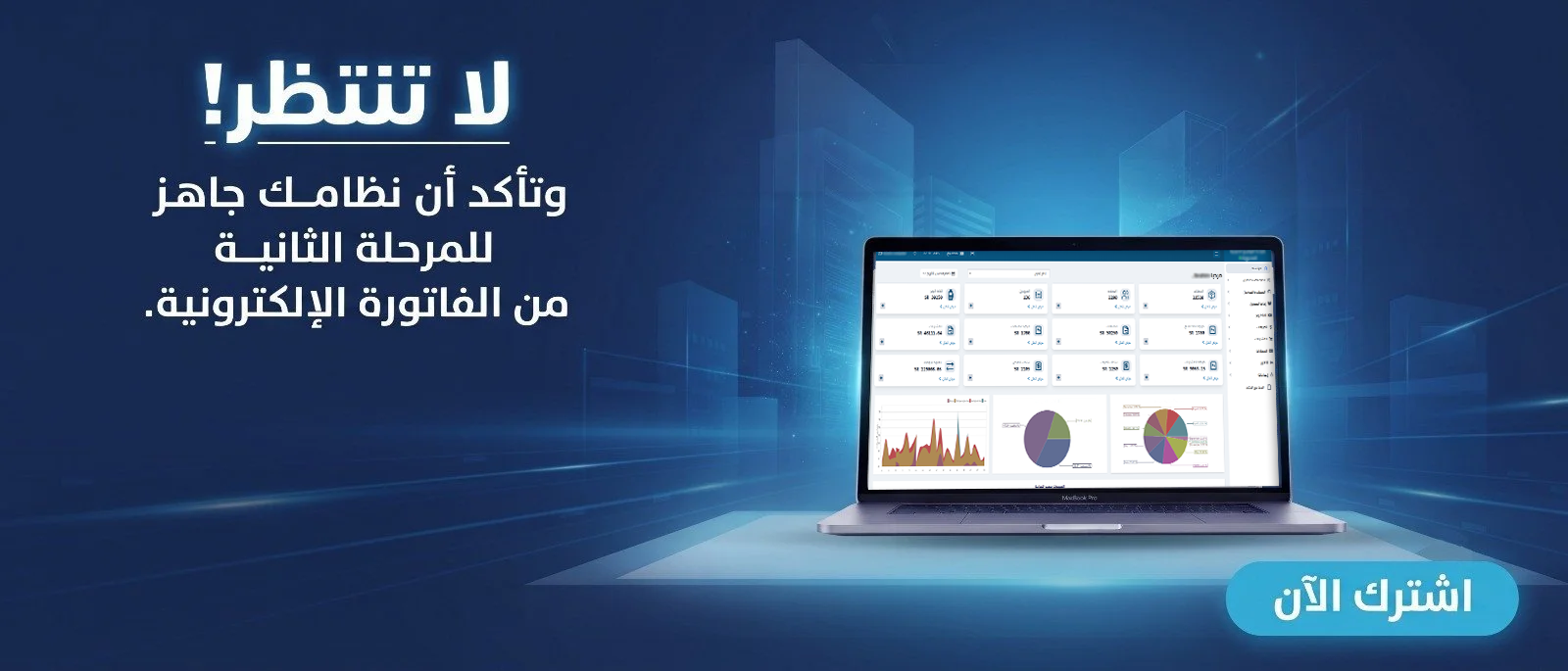
The Zakat, Tax and Customs Authority (ZATCA) outlines the e-invoicing requirements, including issuing and storing invoices electronically, while the second phase requires linking billing systems to the Fatoora platform and issuing invoices in the specified format.
3. Value Added Tax (VAT)
Verify that the system supports various tax statuses and related operations, such as:
- Quotation including tax.
- Quotation before adding tax.
- Item classification.
- Input tax.
- Output tax.
- Discounts.
- Returns.
- Credit and debit notes.
- Tax reports.
4. Inventory
If your business or company relies on selling goods, inventory management is a core component of the system, not just an add-on feature.
It is important to ensure the ability to track:
- Multiple warehouses.
- Inventory transfers.
- Stocktaking operations.
- Item cost.
- Reorder point.
- Barcode.
- Units.
- Returns.
- Damaged items.
- Item movement.
5. Point of Sale (POS)
Stores, restaurants, pharmacies, and other businesses that rely on direct selling need a fast POS system, and it is most effective when directly linked to the accounts.
The Point of Sale solution is suitable for comparison when evaluating systems that combine daily sales operations with accounts, inventory, and reports.
6. Financial and Administrative Reports
Do not compare software based solely on the number of available reports, but ask whether the reports help you answer basic administrative questions:
- Is the company making a profit?
- Which branch is performing best?
- Who are the customers with delayed payments?
- What are the most profitable products?
- In which items are expenses concentrated?
- What is the value of the current inventory?
- What is the liquidity level?
Aamal Raqmia provides smart reporting solutions through which you can track data for sales, invoices, returns, inventory, revenues, expenses, customers, and suppliers.
You can explore smart reporting solutions when management needs a broader view of operational and financial data.
7. Permissions
The cashier should not have the same permissions granted to the financial manager.
Ensure the software allows specifying the users who are able to:
- View item cost.
- Grant discounts.
- Process return operations.
- Delete or modify operations.
- View profits.
- Add users.
- Approve financial operations.
- Close the period.
8. Scalability
Keep in mind what will happen to the software when there is an increase in:
- Number of branches.
- Number of users.
- Number of products.
- Number of warehouses.
- Number of invoices.
- Number of online stores.
Having to change the system after the company expands could be more costly than choosing a solution that can grow with it from the beginning.
Best Accounting Software in Saudi Arabia
The Saudi market features a variety of accounting systems, and the most suitable choice varies according to the facility's size, the nature of its activity, and the functions it needs. Therefore, the following list is not a definitive ranking, but rather a set of options that can be included in your comparison.
| Software | System Type | Most Suitable For | Key Area for Comparison |
|---|---|---|---|
| DigitalPro | Accounting + POS + Inventory | Stores and multi-operation companies | Integration of accounts, POS, and inventory |
| DigitalPro Cloud | Cloud Accounting | Small and Medium Enterprises (SMEs) | Cloud access and accounts |
| Wafeq Wafeq | Cloud | Small and Medium Enterprises (SMEs) | Accounting, Invoicing, and Payroll |
| Qoyod Qoyod | Cloud | Saudi Companies | Accounting, Invoicing, and Integrations |
| Daftra Daftra | Cloud ERP | Businesses that need multiple applications | Comprehensive management, inventory, and sales |
| Odoo | Customizable ERP | Companies with complex operations | Multi-module and customization |
Below we will review the most important features of the DigitalPro and Digital plus systems from Aamal Raqmia Software Company
The DigitalPro accounting system is among the options worth comparing in the Saudi market, as it combines the functions of accounts, sales, inventory, payments, returns, suppliers, warehouses, and reports, in addition to operating points of sale.
It is a suitable option for evaluation when the facility needs:
- Accounts.
- Point of Sale.
- Inventory management.
- Suppliers.
- Warehouses.
- Branches.
- Reports.
- Electronic invoicing.
- POS devices.
The basic idea is to link daily operations with accounting within a single environment, instead of using a separate program for the cashier, another for inventory, and a third for accounts.
Learn about Accounting and POS Solutions.
DigitalPro Cloud
DigitalPlus Cloud is the advanced cloud solution within Aamal Raqmia's solutions, and its official page shows that it allows managing accounts and transactions online with Arabic language support, archiving, and electronic invoicing.
It might be suitable if you are looking for:
- Online accounting software.
- Accessing data from more than one location.
- Managing a small or medium enterprise.
- The ability to work remotely.
- Reducing reliance on a server located in the office.
You can review the Cloud Accounting Solutions.
Aamal Raqmia's specialized content also covers the topic of online accounting software to help companies understand the nature of cloud work and its suitability for their needs.
What is the best accounting software for small businesses?
The best software for small businesses is the one that gives them the functions they actually need without adding unnecessary complexities or costs, while providing the ability to upgrade usage when the activity expands in the future.
A small facility often needs:
- Creating invoices.
- Recording expenses.
- Customer management.
- Supplier management.
- Tracking collections.
- Value Added Tax (VAT).
- Electronic invoicing.
- Statements of account.
- Income statement.
- Financial position.
- Clear and simplified reports.
If the company sells products, it is important to add:
- Inventory management.
- Purchases.
- Barcode.
In case there is a store:
- Point of sale (POS).
If it operates from more than one location:
- Branch management or cloud system.
Therefore, the appropriate solution for a consulting firm may not be the same one most suitable for a supermarket or restaurant.
Discover: The best accounting solutions for small businesses in Saudi Arabia
What is the best cloud accounting software?
The best cloud accounting software is the one that provides easy access from anywhere, along with the accounting functions the facility needs, while providing security elements, permission management, e-invoicing, and advanced reports.
Among the cloud solutions that can be included in the comparison options in Saudi Arabia is the DigitalPlus cloud accounting system provided by Aamal Raqmia.
What is the difference between online accounting software and desktop software?
Online accounting software relies on cloud infrastructure to access data and the application, whereas desktop software is usually installed on the facility's devices or a local server.
| Comparison | Online Accounting Software | Desktop Software |
|---|---|---|
| Run Location | Cloud | Device or local server |
| External Access | Easier | Requires setup |
| Software Update | Mostly centralized | Requires local updates |
| Branch Management | Relatively easier | May need additional linking |
| Working Offline | Depends on the system | Might be better |
| Technical Infrastructure | Less reliant on internal server | The facility manages the infrastructure |
| Cost Model | Mostly subscription-based | License or subscription |
A desktop solution may be more appropriate for environments requiring continuous local operation, while a cloud solution is more suitable when management needs to access the system from multiple locations.
For this reason, Aamal Raqmia provides the DigitalPro system for accounts and POS, alongside DigitalPlus as an advanced cloud solution.
What is meant by accounting software approved by the Zakat and Income Authority?
The term "accounting software approved by the Zakat and Income Authority" in commercial use refers to an accounting or billing system that supports the e-invoicing requirements issued by the Zakat, Tax and Customs Authority (ZATCA), and can be configured to issue, store, and link invoices to the Fatoora platform.
However, there is a fundamental point to note: the accounting system used must comply with the e-invoicing requirements, which is available at Aamal Raqmia company as it is certified within the list of e-invoicing service providers.
Read also: Accounting software compliant with ZATCA requirements
Prices of accounting software in Saudi Arabia
The prices of accounting software in Saudi Arabia vary according to a set of factors related to the scope of the solution and the required services.
Among the most prominent elements affecting the price:
- Subscription duration.
- Number of branches.
- Number of facilities.
- Inventory management.
- Point of sale.
- Payroll.
- Cost centers.
- API linking and integration API.
- Electronic invoicing.
- Storage space.
- Support.
- Training.
- Data migration.
- Customization.
- Devices/Hardware.
To find out details regarding subscriptions and available options, you can review packages and prices or contact the solution provider of your choice.
The best accounting system for companies by business type
The most accurate way to choose the best accounting system for companies is to start by defining the nature of the business and its needs before comparing brands.
Service Companies
Often need:
- Customer management.
- Quotations.
- Invoices.
- Expenses.
- Collections.
- Cost centers.
- Projects.
- Reports.
A simple cloud solution might be sufficient if the facility does not have inventory or POS.
Trading and Distribution Companies
These companies need:
- Sales management.
- Purchasing management.
- Inventory.
- Multiple warehouses.
- Sales representatives.
- Customers and suppliers.
- Payment terms.
- Measuring item profitability.
In this case, the value of an integrated system that links operations together increases.
Retail Stores
Usually need:
- POS.
- Barcode.
- Cashier.
- Inventory.
- Stocktaking.
- Returns.
- Discounts.
- Shifts.
- Payment methods.
- Accounts.
You can compare a Point of Sale system when looking for a solution that supports daily sales operations linked to account management.
Restaurants and Cafes
Need:
- Fast POS.
- Table management.
- Order management.
- Kitchen.
- Takeaway.
- Delivery.
- Inventory.
- Item recipes/ingredients.
- Meal costing.
- Invoices.
- Accounts.
Therefore, a restaurant and cafe management system can be utilized when evaluating appropriate solutions for this type of operations.
Multi-branch Companies
Look for solutions that provide:
- Centralized management.
- Permissions tied to each branch.
- Separate inventory.
- Transfer operations.
- Detailed and consolidated reports.
- Remote monitoring capability.
- More than one point of sale.
Larger Companies
May need an ERP system covering:
- Financial management.
- Sales.
- Inventory.
- Procurement/Purchasing.
- Projects.
- Human Resources.
- CRM.
- Industry-specific custom operations.
How do you know that your company needs an ERP system instead of accounting software?
The need for an ERP may become more apparent when multiple departments rely on the same data, and manually transferring information between them increases the likelihood of errors.
Indicators of this include:
- Repeatedly entering the same data.
- Discrepancies between inventory and accounts.
- Delay in generating reports.
- Expansion in the number of branches.
- Using multiple different programs.
- Difficulty determining project costs.
- Lack of a centralized data source.
- The need for approval workflows.
- An increase in the number of users.
When these situations arise, it is not enough to look at an accounting software alone, but the entire operational ecosystem must be evaluated.
The most important reports that the best accounting software should provide
The primary task of good accounting software is not just storing data, but converting it into information that helps management make decisions.
Among the most prominent reports that should be available:
Accounting Reports
- Trial Balance.
- General Ledger.
- Income Statement.
- Financial Position / Balance Sheet.
- Cash Flows.
- Cost Centers.
Customer Reports
- Statements of Account.
- Aging of Receivables/Debts.
- Due Invoices.
- Collections.
Suppliers
- Supplier Balances.
- Due Invoices.
- Purchases.
- Payments.
Inventory
- Item Balances.
- Inventory Value.
- Item Movement.
- Slow-moving / Stagnant Items.
- Best-selling Items.
- Reorders.
Sales
- Branch Sales.
- Employee Sales.
- Product Sales.
- Returns.
- Discounts.
- Payment Methods.
Aamal Raqmia provides an independent portal for smart reporting that allows displaying data on sales, invoices, returns, inventory, financial statements, and tax compliance.
Discover Smart Reporting Solutions if management needs a more comprehensive view of operational and financial data.
Common mistakes when choosing the best accounting software
Choosing the cheapest software
Price is an important factor in the decision, but it is not enough on its own to determine the appropriate system.
When the software does not cover your needs, you may later incur costs associated with:
- Using additional software.
- Entering data manually.
- Development.
- Errors.
- Migrating to another system.
Not testing returns
Issuing a successful invoice might be easy, but the real test appears when executing non-standard operations.
Test:
- A full return.
- A partial return.
- A credit note.
- A discount.
- Canceling a transaction.
- A partial payment.
Ignoring Inventory
If your business is based on selling products, test stocktaking, transferring, and costing before making a subscription decision.
Not testing reports
Ask the software provider in front of you to extract an income statement, a statement of account, and an inventory report.
Ignoring permissions
Using a system that does not provide clear permissions can pose a risk to the facility's financial and operational aspects.
Not asking about data
Ask about the following points:
- Can I export my data?
- What is the export format?
- What happens to the data after canceling the subscription?
- How are backups performed?
How do you test the best accounting software before purchasing?
Apply the following scenario during the software demo.
Sales
- Add a new customer.
- Create an invoice.
- Enter a discount.
- Record a partial payment.
- Execute a return operation.
- Extract the customer's statement of account.
Purchases
- Add a supplier.
- Record a purchase invoice.
- Receive the quantity into inventory.
- Record a payment.
- Check the supplier's balance.
Inventory
- Add an item.
- Purchase a quantity of it.
- Sell part of the quantity.
- Transfer the quantity between two warehouses.
- Perform a stocktake.
- Extract the item movement report.
Accounts
Check:
- The resulting journal entry.
- General Ledger.
- Trial Balance.
- Income Statement.
- Financial Position / Balance Sheet.
Electronic Invoicing
Test:
- Tax invoice.
- Simplified invoice.
- QR.
- XML when needed.
- Credit note.
- Integration status with Fatoora platform if your facility is in Phase Two.
Users
Create accounts for different users, such as:
- Manager.
- Accountant.
- Seller / Salesperson.
- Cashier.
Then verify the limits of permissions granted to each user.
If the system manages to pass this scenario easily, you can then move on to comparing price, support, and scalability options.
Why is DigitalPro considered one of the best accounting software in Saudi Arabia?
DigitalPro is a suitable choice for facilities looking to combine accounts, POS, inventory, and reports in a single system, especially commercial businesses where item movement is directly linked to sales operations.
The system provides tools for managing sales, payments, invoices, returns, inventory, suppliers, warehouses, and reports.
Aamal Raqmia's solutions also include:
- DigitalPro for accounts and POS.
- DigitalPro Cloud.
- Solutions for restaurants and cafes.
- CRM.
- Hotel management.
- Smart reporting.
- Other sector-specific solutions.
Book a demo, and request the execution of a sales, purchasing, inventory, e-invoice, and reporting cycle in front of you.
You can also register and get the trial period or book your consultation to determine the solution compatible with the size of your company and the nature of its activity.
Frequently Asked Questions about the best accounting software in Saudi Arabia
What is the best accounting software in Saudi Arabia?
There is no single best accounting software suitable for all companies, because the decision is linked to the nature of the business, the size of the facility, inventory volume, the number of users and branches, and the need for POS and electronic invoicing.
DigitalPro can be put up for comparison when the facility needs accounts, inventory, and POS in an interconnected environment, alongside the advanced DigitalPlus accounting system.
What is the best accounting software for small businesses?
Look for organized and user-friendly software that supports invoices, expenses, customers, suppliers, taxes, and reports, with the possibility of later expansion when inventory or branches are needed.
DigitalPro Cloud is considered one of the cloud solutions provided by Aamal Raqmia for small and medium enterprises.
Is cloud software better than desktop software?
Not necessarily in all cases; a cloud system is characterized by easy access and management of different locations, while local operation may be more suitable for facilities facing unstable internet connections or with special technical requirements.
Is there an online accounting software?
Yes, there are several options for online accounting software in Saudi Arabia, including DigitalPro Cloud, Wafeq, Qoyod, and Daftra.
These solutions vary in terms of functions, prices, number of users, branches, and integrations.
What are the prices of accounting software in Saudi Arabia?
Prices vary significantly depending on the package, the number of users, branches, functions, and the subscription duration.
Is there free accounting software?
There are some free plans or free trials for a limited period, but before relying on them for actual business, you must review user limits, the number of invoices, reports, and the level of support.
Are accounting software approved by the Zakat and Income Authority better?
The more accurate approach is to verify the system's compliance with the ZATCA requirements that apply to your facility, noting that the Authority's list of solution providers is indicative and does not imply an endorsement of the technical solutions themselves.
How do I know if the software is compliant with electronic invoicing?
Verify the system's ability to issue tax and simplified invoices and notes, and its fulfillment of the specific technical requirements for your facility, in addition to linking with the Fatoora platform if the facility is included in the second phase.
Is Excel an alternative to accounting software?
Excel can be used for analysis and some calculations, but on its own, it does not provide an integrated cycle for managing sales, inventory, permissions, e-invoicing, and operation logs as the facility expands.
What is the difference between accounting software and ERP?
Accounting software focuses primarily on financial operations, while an ERP connects finance with other departments such as sales, inventory, procurement, projects, and human resources.
When does a company need to change its accounting software?
Among the most important indicators:
- Delayed reports.
- Re-entering data multiple times.
- Increasing reliance on supplementary Excel files.
- Existence of discrepancies in inventory.
- Weak branch management.
- Lack of appropriate permissions.
- Difficulty keeping pace with expansion.
- The need for integrations not provided by the system.
Conclusion:
If you are looking for the best accounting system for companies that connects accounts with sales, POS, inventory, and reports, you can explore DigitalPro, or check out cloud solutions if the priority is for an online accounting system.
Discover Aamal Raqmia's services and products, then book a demo and test the system on a real workflow within your company before making a purchasing decision.
Start managing your business with full flexibility
Try Aamal Raqmia for free. Start issuing your ZATCA-compliant electronic invoices in minutes.