Best Point of Sale POS Device in Saudi Arabia
Choosing the best POS device is not related to appearance or cost alone, as the device represents an essential part of the daily sales process, and any slowdown or downtime may cause customer delays, errors in recording invoices and payments, as well as difficulty verifying the alignment of sales with inventory and accounts.
The importance of this increases in the Saudi market with the remarkable expansion in the use of electronic payment methods, as the Saudi Central Bank clarified that electronic payments reached 85% of the total number of payment transactions in the retail sector for individuals during 2025.
In this guide, we review how to choose the best POS device in Saudi Arabia, the most prominent specifications to pay attention to, and when the Digital H6 POS device can be a suitable choice, in addition to how to link the device to the sales, inventory, and accounting software.
What is a Point of Sale (POS) Device?
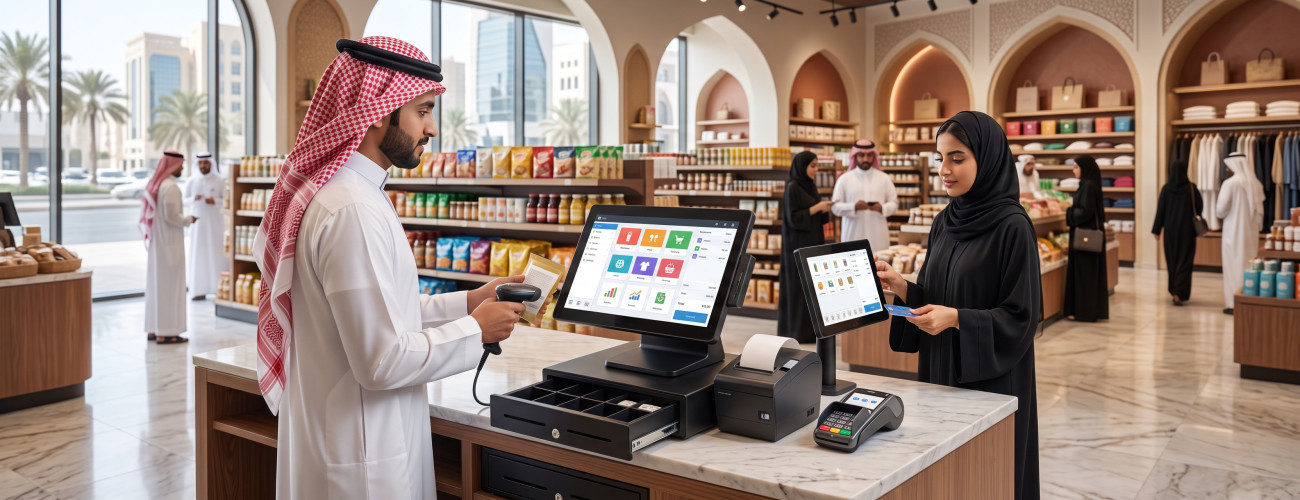
A POS device is the equipment used at the sales counter to run the POS software, enter products or services, and complete the invoicing process. It may come in the form of a touch screen, an All-in-One device, a tablet, or a desktop cashier device.
The cashier device often operates within a system comprising a number of devices and components, including:
- Barcode scanner.
- Invoice printer.
- Cash drawer.
- Customer display screen.
- Bank payment terminal.
- Electronic scale for certain activities.
- POS software.
- Item and pricing database.
Digital Works clarifies in the POS guide that the POS system is not limited to the cashier device, but may extend to include the software, inventory, customers, accounts, reports, and payment methods.
For more: You can learn about the Point of Sale system and how to employ it in managing sales operations.
What is the difference between a cashier device and a bank payment terminal?
There is a clear difference between the cashier device and the bank payment terminal, and knowing this difference is a fundamental step before searching for the best POS device.
|
Comparison |
POS Cashier Device |
Bank Payment Terminal |
|---|---|---|
|
Function |
Managing sales operations and issuing invoices |
Receiving the transaction value using a card |
|
Products and Prices |
Managed through the POS software |
Usually does not manage them |
|
Inventory |
Can be integrated with the inventory system |
Does not manage inventory |
|
Invoices |
Issues the sales invoice |
Issues a payment receipt |
|
Reports |
Sales, inventory, shift reports, etc. |
Reports specific to payment transactions |
|
Provider |
POS devices or solutions supplier |
Bank or qualified payment service provider |
|
Integration |
Can be integrated with accounts |
Can be integrated with POS software |
The "Mada" POS devices service specializes in accepting payments and linking the payment process between the merchant and the parties connected to the payment network, while the cashier device manages the sales process itself.
Therefore, if the goal is to manage a store or a restaurant, you will mostly need a cashier device and POS software, and you may also need a bank payment terminal alongside them.
What are the specifications of the best POS device?
The best device is the one that can run your software efficiently and stably during working hours, and is compatible with other devices needed by the business, which is available in the appropriate POS solution for the cashier environment.
Among the most important criteria to review when choosing a device:
Processor Speed and Memory
During peak times, the device should not cause customer delays when searching for an item, reading a barcode, or generating an invoice.
Therefore, you should check:
- Processor class.
- RAM capacity.
- Storage drive type.
- Technical requirements for the POS software you will rely on.
A suitable screen for the cashier
A touch screen contributes to faster usage, especially in:
- Restaurants.
- Cafes.
- Supermarkets.
- Retail stores.
It is important that the screen is comfortable for the employee when used repeatedly throughout the shift.
A second screen for the customer
Allows the customer to view:
- Items.
- Prices.
- Discounts.
- Total invoice value.
Thus, it helps review transaction details and detect errors before completing the payment, and makes the sales process clearer to the customer.
Peripheral devices compatibility
Before buying the device, verify its compatibility with:
- Thermal printer.
- Barcode scanner.
- Cash drawer.
- Customer display.
- Card reader.
- Electronic scale if needed.
The POS system also offers support for multiple classes of printers, barcode scanners, customer displays, card readers, and electronic scales.
Discover: POS system and sales operations management.
Best POS Device in Saudi Arabia: Is Digital H6 POS suitable?
The Digital H6 POS is one of the options that can be placed on the evaluation list when searching for the best POS device in Saudi Arabia for stores, restaurants, and companies, especially when there is a need for an All-in-One device to run cashier software and manage sales.
The device comes with the following specifications:
- Intel Core i5-5200U processor at 2.2GHz.
- 8GB RAM.
- 128GB SSD storage.
- Primary LED screen.
- Support for adding a second customer screen.
- All-in-One design.
The page also presents the device as configured to work with cashier, sales management, and inventory systems, with a design that contributes to reducing separate components on the counter.
These specifications can be evaluated within the business needs before choosing the device and linking it to the system being used.
Why is buying a POS device without POS software not enough?
The device alone does not have product pricing information, inventory balances, or sales data, as these functions come from the POS software running on it.
When connecting the device to an integrated POS system, a single transaction can execute a set of actions, including:
- Reading the item's barcode.
- Retrieving the price and tax.
- Calculating the allowable discount.
- Selecting the payment method.
- Issuing the invoice.
- Deducting the quantity from inventory.
- Recording shift sales.
- Updating the facility's accounts.
- Adding the transaction to reports.
The system combines sales, inventory, accounts, and reports, while providing management for returns, payment methods, suppliers, and warehouses.
For this reason, it is preferable to treat the device and software as a single ecosystem, instead of buying the device first and then discovering that the software is incompatible with it or does not work properly with the printer or barcode scanner.
Review: POS System and Sales Management.
What is the best POS device for restaurants and cafes?
Restaurants need a device capable of handling high order volumes and running smoothly with the system that manages the dining area, kitchen, and inventory.
It is better to look for a device that offers:
- An easy and fast-to-use screen.
- Stable performance during peak times.
- Support for order printers.
- The ability to add a customer screen if needed.
- Easy connection to a barcode scanner.
- Compatibility with restaurant management software.
- The ability to integrate with payment methods.
But the most important factor remains the system running behind the device; because the restaurant needs to manage orders, tables, takeaway, delivery, inventory, and ingredient costs, not just issue a sales invoice.
For these activities, you can rely on the Restaurant and Cafe Management System within the appropriate POS environment.
What is the best POS device for stores and supermarkets?
Retail businesses need a fast device to handle a large number of items and enter or scan them, with the ability to operate peripheral devices connected to the point of sale.
Focus on:
- Barcode scanner.
- Touch screen.
- Printer.
- Cash drawer.
- Customer screen.
- Scale in the supermarket.
- Device stability.
- POS software speed.
The system must also support:
- Offers and discounts.
- Return processes.
- Multiple units.
- Inventory management.
- Expiration dates when needed.
- Shift management.
- Sales reports.
POS system functions include handling barcodes, weights, returns, expiration dates, and item and inventory management, so the device should be evaluated alongside the software instead of looking at each component separately.
Is there a POS device for individuals?
The term "POS device for individuals" may be used to indicate two different situations.
If the intention is a cashier device to manage an individual project, the store or small business owner can use a cashier device with POS software that fits the nature of their business.
However, if the intention is a bank payment terminal to accept Mada and bank cards, it is a service directed at merchants and business owners, and is linked to settling payments through the merchant's account with the acquiring bank. The Saudi Central Bank defines a merchant account as the account used to settle POS transactions.
The SoftPOS service is also available, which allows merchants in some cases to accept Mada cards and payment networks using eligible Android devices, without the need for a standalone payment terminal.
Consequently, the need must be determined first: is the requirement a device to manage sales or a terminal to accept bank payments?
How to request a POS device
The method of obtaining a POS device depends on the type of device you need.
If you want a POS Cashier Device
The steps usually proceed in this order:
- Determine the type of business.
- Choose the POS software.
- Check the technical requirements of the software.
- Select a device compatible with it.
- Choose the printer, barcode scanner, and additional screen.
- Install the system.
- Enter items and prices.
- Test sales and return operations.
- Train the cashiers on usage.
You can start by registering and getting a free trial, then ensuring the solution is suitable for the business size and the device used.
If you want a Bank Payment Terminal
The payment acceptance service is requested from the bank or payment service provider according to the requirements specified by the contracting entity, and conditions and required documents may vary depending on the service provider and business nature.
Therefore, you should not confuse getting a payment terminal with buying a cashier device.
How do you test the device before purchasing?
Before approving the device, it is best to conduct a test simulating actual workload:
- Run the POS software.
- Search for a set of products.
- Use the barcode scanner.
- Create an invoice containing multiple items.
- Print the invoice.
- Execute a return transaction.
- Open more than one screen within the system.
- Test the customer display.
- Test the printer.
- Close the shift.
- Extract the sales report.
It is not recommended to buy devices first and then search for a suitable software, as this is a recurring mistake when setting up points of sale.
Common mistakes when choosing a POS device
Avoid the following mistakes:
- Choosing the device based on price alone.
- Buying a device with limited capabilities to reduce cost.
- Ignoring the technical requirements of the POS software.
- Not testing the printer and barcode scanner.
- Confusing the cashier device with the payment terminal.
- Not taking peak times into account.
- Neglecting the importance of the customer screen.
- Not paying attention to maintenance and support.
- Skipping the returns test.
- Buying the device before determining the accounting system.
- Not being prepared for expansion and adding branches.
The device you choose should be able to continue serving the business as the number of items and invoices grows.
Frequently Asked Questions about the best POS device
What is the best POS device?
The best device is the one that delivers stable performance and is compatible with the POS software, printer, barcode scanner, and the rest of the devices used in the business. The Digital H6 POS is one of the available options at Aamal Raqmia for stores, restaurants, and companies.
What is the best POS device in Saudi Arabia?
One single device cannot be considered the best option for all businesses, as choosing the device depends on sales volume, software used, operating hours, and devices connected to it. Digital H6 POS can be evaluated when an All-in-One device with an i5 processor, 8GB RAM, and SSD is needed, with the ability to add a second screen.
Is the POS device the same as the Mada terminal?
Not necessarily; the POS cashier device manages the sale, invoice, and items, while the payment terminal specializes in collecting the transaction value using cards. The two devices can be linked within the sales process.
Can a POS device be requested for individuals?
An individual business owner can purchase a cashier device to manage their project, while bank payment acceptance terminals are linked to services customized for merchants and are subject to requirements set by the bank or payment service provider.
Do I need a powerful device if the store is small?
That depends on the software used, the number of products, invoices, and connected devices. A small business does not necessarily need the highest available specifications, but it needs a device that meets the software requirements and runs without lagging.
What devices can be linked to a POS system?
Depending on the system used, printers, cash drawers, barcode scanners, customer displays, card readers, and electronic scales can be connected. The POS system also offers support for these categories of devices.
Conclusion
Determining the best POS device begins with clarifying the actual need: is the requirement a cashier device to run sales software, a payment terminal to accept cards, or an integrated system combining both?
For stores and restaurants, the device should not be evaluated separately from the software; because the primary benefit of a POS system appears when linking the invoice to inventory, accounts, returns, shifts, and reports.
The Digital H6 POS is one of the options that can be included in the evaluation when searching for the best POS device in Saudi Arabia, especially for those who need an All-in-One device with the option of adding a second screen and suitable specs to run cashier systems.
You can discover the appropriate solution through the POS System and linking it to the sales, inventory, and accounting management ecosystem.
To find out the most suitable solution for the nature of your business, you can review the Packages and Prices or Register and get a free trial to test the system before fully equipping the point of sale.
Start managing your business with complete flexibility
Try Aamal Raqmia for free. Start issuing your ZATCA-compliant electronic invoices within minutes.