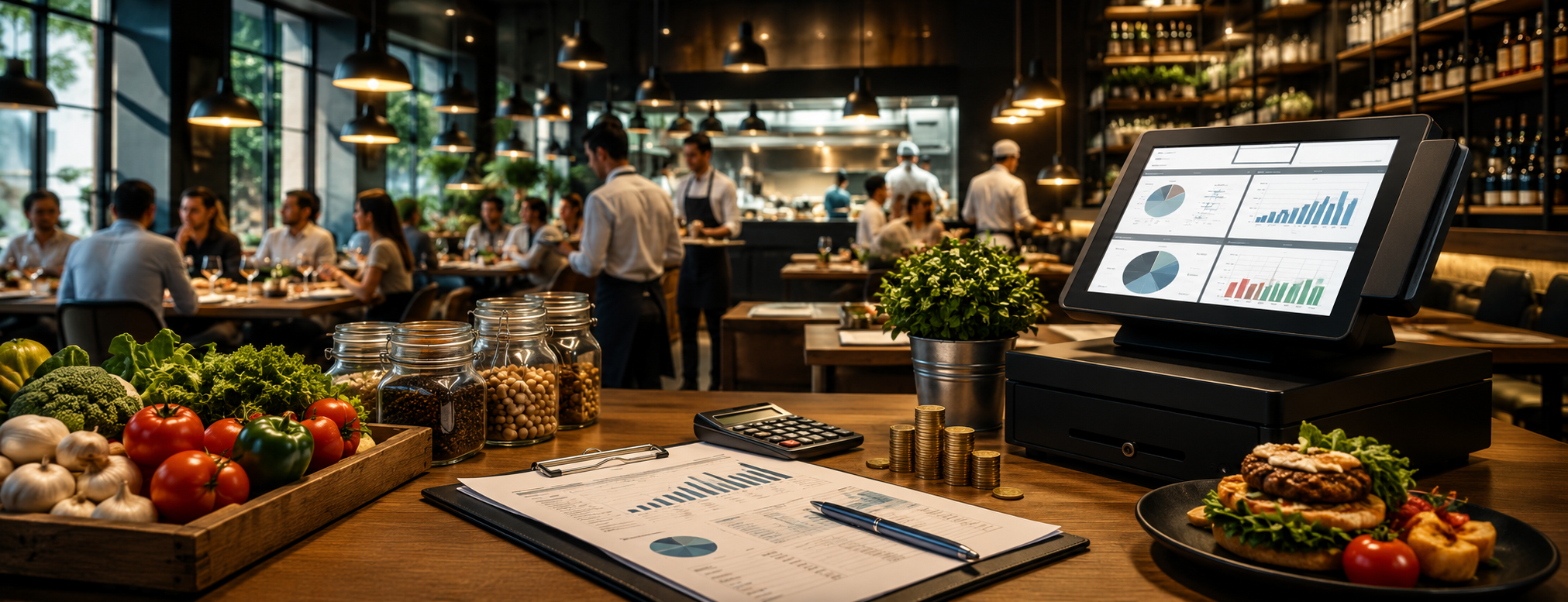
Restaurant accounting: A guide to cost and profit control in Saudi Arabia
Restaurant Accounting: A Guide to Controlling Costs and Profits in Saudi Arabia
Your restaurant may record high revenues, but at the same time face a decline in profits or a shortage in cash liquidity for incomprehensible reasons. In most cases, the flaw is not in poor sales, but rather due to shortcomings in accurate meal pricing, increased waste rates, inventory variances, or failure to reconcile point-of-sale revenues with cash collections, digital payments, and delivery platform revenues.
Herein lies the true value of financial management for restaurants. It represents a comprehensive system where sales intertwine with purchases, warehouse management, employee wages, expenses, and tax obligations, and its function is not limited to merely recording invoices at the end of each month.
This article aims to explain the mechanisms of accounting organization for the food sector, the most prominent metrics to monitor, methods of pricing dishes, and extracting profit margins. It also reviews the necessity of integrating accounting systems with a point of sale system, as well as electronic invoicing requirements and criteria for selecting software solutions compatible with the nature of your business in the Kingdom of Saudi Arabia.
Restaurant Accounting
Accounting organization in restaurants refers to recording, classifying, and studying all financial transactions and operational activities related to the facility; such as buying and selling transactions, warehouse inventory, wages, miscellaneous expenses, damaged materials, and tax obligations. The goal of this is to determine actual costs and know the level of profits and the financial position of the project with complete transparency to facilitate strategic decision-making.
Financial management in the hospitality sector is characterized by its fundamental difference from other commercial sectors; as a single sales transaction intertwines with several variables at the same moment.
For example, when serving a meal to a customer, the sales value, payment method, and imposed taxes must be proven. This is accompanied by withdrawing the components of this dish from the inventory, calculating the cost of raw materials, plus the proportional share of labor and operating costs.
The accounting cycle for restaurants and cafes usually includes the following elements:
Dine-in, takeout, and delivery services revenues.
Inbound cash flows and digital transfers.
Supply operations for basic materials, beverages, and packaging supplies.
Inventory levels and component withdrawal rates.
The actual cost of each dish or beverage sold.
Working staff salaries and shift systems.
Rental expenses, basic services, and maintenance work.
Discounts, promotional offers, and complimentary hospitality.
Damaged materials, waste, and staff meals.
Fees deducted for delivery applications and payment platforms.
Value-added taxes and electronic invoicing system.
Profit margins, loss rates, and cash movement.
For this reason, restaurant and cafe management lacks highly accurate operational and financial statistics; relying on total sales alone will not reveal whether your project is reaping net profits or merely increasing sales volume with weak marginal prices.
If you are facing administrative or financial challenges in your project, hurry now to register and get the trial period to elevate your business.
How is Restaurant Accounting Done?
Accounting operations in the restaurant sector are managed according to a continuous loop starting from setting up the chart of accounts and defining products and their ingredients, through monitoring sales, supply, and expense movements, and finally to reconciling financial movements, conducting inventory operations, and extracting financial statements and regulatory reports.
Below is a practical sequence for applying the restaurant accounting methodology:
Establishing a chart of accounts compatible with the restaurant's activity
Main accounts should be classified into revenue, expense, asset, liability, and inventory items. Sub-items fall under them, such as dine-in revenues, delivery revenues, app deductions, food and beverage costs, wages, and rents.
Listing products and defining their recipes
The ingredients of each dish must be accurately accounted for, in addition to determining quantities, weight units, and potential waste rates. For instance, the cost of a meat meal is not limited to meat alone but extends to include bread, toppings, vegetables, packaging, and any materials related to its production. A restaurant and cafe management system makes it easy to control and organize these recipes.
Documenting supplies and managing suppliers
Purchase invoices are recorded including prices, quantities, taxes, and the supplier's name, to then enter the materials into the warehouse. It is necessary to match supplier invoices with purchase orders and received quantities, a task in which an advanced procurement system excels.
Integration with cashier points of sale
Details of each sale transaction should flow automatically from the cashier device to the accounting and inventory systems, showing the product type, quantity, value, discounts, taxes, payment method, and the location or shift of the sale.
Monitoring all sales outlets
It is important to isolate dine-in sales from takeout, apps, and phone orders; given that each outlet has different operational costs and fees.
Daily closing of shifts
A comprehensive reconciliation is conducted for the sales of each shift with the actual cash in the drawer, bank card receipts, digital payments, and delivery orders, along with recording returns and canceled movements.
Recording expenses and wages
This requires recording daily and monthly expenses within their designated items, with the importance of distinguishing between operating expenses, purchased assets, and prepaid expenses.
Implementing continuous warehouse inventory
Comparisons are made between actual balances in the warehouse and those recorded in the automated system. This step helps monitor loss, discover errors in recipe quantities, or track unbilled orders.
Calculating the cost of sales
The value of the raw materials that actually went into preparing the dishes and beverages sold during a specific time period is extracted.
Preparing statements and auditing
Income statements are examined, material and labor costs are analyzed, sales of each item are evaluated, and inventory balances and liquidity movement are reviewed, as well as revenue analysis for each branch and shift.
Relying on comprehensive technical systems reduces the burden of repetitive manual entry between the cashier, warehouses, and financial entries, but it does not exempt management from the responsibility of accounting oversight and reviewing the accuracy of recipes and the validity of balances and granted permissions.
Key Elements of Restaurant Accounting
The financial management of restaurants relies on a package of operational and financial standards that reveal the truth behind total revenue numbers. Prominent among them are: cost of goods sold, profit margin, labor expenses, table turnover rate, individual spending share, and coverage rate of each product.
Calculating Cost of Goods Sold (COGS)
The cost of goods sold expresses the total expenses on basic materials, beverages, and packaging tools that went into manufacturing the products sold during a specific period.
It is extracted based on the following formula:
Cost of Goods Sold = Beginning Inventory + Net Purchases − Ending Inventory
For example, if the beginning inventory for the month equals 40,000 riyals, supplies reach 90,000 riyals, and then the end-of-month balance settles at 35,000 riyals, the result would be:
Cost of Goods Sold = 40,000 + 90,000 − 35,000 = 95,000 Riyals
It is necessary to take returns, damages, staff meals, and transfers between branches into account when evaluating the result; so that these differences are not mistakenly treated as actual sales.
It is also advisable to conduct a comparison between the actual cost and the standard cost derived from the recipes:
Standard (Theoretical) Cost: Materials that were supposed to be consumed based on fixed quantities and sales volume.
Actual Cost: Quantities consumed on the ground based on inventory operations and purchase invoices.
Variance Rate: The gap between the actual and standard costs.
An increase in this variance indicates the presence of waste, non-compliance with portion standards, a flaw in inventory operations, or a failure to record some sales movements.
Gross Profit and Gross Profit Margin
Gross profit is defined as the surplus of net sales after deducting the value of goods sold, prior to deducting other operating expenses such as rents, wages, and marketing.
Gross Profit = Net Sales − Cost of Goods Sold
While the gross profit margin measures the percentage of this profit compared to the volume of net sales:
If sales excluding tax equal 250,000 riyals, and the cost of materials is 95,000 riyals:
The gross profit will amount to 155,000 riyals.
The gross profit margin will reach 62%.
Achieving this margin is not conclusive evidence of the facility's profitability in the end; as the deduction of workers' wages, administrative expenses, commissions, financing, and rent remains to clarify the picture.
It is always preferable to exclude value-added tax from net sales when measuring profitability rates, as they are tax trusts and not special revenue for the restaurant.
Customer Retention Rate and Customer Acquisition Cost (CAC)
The retention rate reflects the facility's ability to attract previous visitors again within a specific timeframe. This metric is essential because customer loyalty reduces the financial burdens associated with attracting new customers.
This percentage is calculated using the formula:
Customer Retention Rate = ((Customers at End of Period − Newly Acquired Customers) ÷ Customers at Start of Period) × 100
While the cost of acquiring a new customer is measured in the following way:
Acquisition Cost = Total Advertising and Acquisition Campaign Expenses ÷ Number of New Customers
Accurately measuring these rates in the restaurant sector requires loyalty systems, recording phone numbers, or ordering via digital platforms. You must avoid counting every order as a new customer, as it is possible for the same customer to order multiple times.
To organize this data, you can rely on a distinct system for effective interaction and utilize the Digital Sender which helps manage direct communication, execute advertising campaigns efficiently, and interact automatically with customers according to established policies.
Table Turnover Rate
This indicator refers to the number of times a single table is occupied by different guests within a specific timeframe.
It is extracted through the mathematical process:
Table Turnover Speed = Number of Parties Served ÷ Total Available Tables
If the restaurant welcomed 60 parties during the dinner service period, and it owns 20 tables:
Turnover Rate = 60 ÷ 20 = 3 Turns
A high indicator denotes optimal investment of space, but it is stipulated that this should not be at the expense of customer comfort and service level. This rate must be studied in parallel with the invoice value and average seating time.
If the turnover rate is low, this may be due to:
Delay in taking orders.
Slowness in meal preparation processes.
Lack of harmony between the dining room staff and kitchen teams.
Slowdown in issuing and collecting invoices.
Poor management of reserved tables.
Delay in cleaning and preparing tables after guests leave.
Average Revenue Per Guest or Customer
This metric highlights the approximate spending outcome per individual in the restaurant.
Average Customer Spending = Net Sales ÷ Number of Visitors
If your sales were 80,000 riyals and your guests reached 4,000 visitors:
Average Customer Spending = 20 Riyals
There is a difference between this number and the average invoice value, which is calculated as follows:
Average Invoice Value = Net Sales ÷ Total Number of Invoices
A single invoice may include several individuals, so the correct indicator must be employed when designing packages or evaluating the performance of sales and service teams.
The average visitor spending can be elevated through:
Instructing the staff to suggest side dishes or appetizers.
Designing complete meals with added value.
Highlighting dessert and beverage options attractively.
Studying products that are frequently ordered together.
Creating discounts that do not harm the profit margin.
Average Number of Customers
The average number of visitors gives you a clear view of the demand for your facility across different periods (daily, weekly, or monthly).
Daily Average Visitors = Total Customers in a Specific Period ÷ Number of Working Days
This number can be detailed and classified based on:
Hours.
Days.
Shifts.
Branches.
Ordering platforms.
Order type (dine-in, pickup, delivery).
Holidays and weekdays.
Seasonal periods and promotional offers.
This analysis contributes to scheduling shifts, estimating pre-preparation volumes, avoiding food shortages, and linking revenue growth to footfall density.
If revenues escalate while the number of guests remains constant, this means an increase in average invoices. If numbers increase and average spending declines, the reason may lie in a tendency towards lower-priced dishes or as a result of promotional offers.
Labor Cost Percentage
This indicator clarifies the percentage of amounts paid to the staff compared to the volume of net sales.
Labor Expense Ratio = (Total Labor Salaries and Wages ÷ Net Sales) × 100
This cost usually includes:
Basic wages and salaries.
Overtime allowances.
Bonuses and incentives.
Commission percentages.
Any other functional expenses incurred by management.
These expenses should be studied and broken down by shifts, branches, or departments; as the overall percentage may hide an overstaffing during slump times.
It is not advisable to rush to reduce the number of employees merely by looking at this percentage alone; because excessive downsizing will slow down service, weaken quality, and alienate customers. The primary goal is to create a deliberate balance between the cost of human resources, expected demand volume, and service levels.
Overhead Rate, Prime Costs, and Food Cost
Overhead represents all operational costs not directly related to meal production; such as rent expenses, utilities, maintenance work, insurance, administrative fees, and subscriptions.
Overhead Ratio = (Total Overhead Expenses ÷ Net Sales) × 100
As for prime costs, they include the two largest consumption elements in the food sector:
Prime Costs = Cost of Goods Sold + Labor Expenses
Monitoring prime costs is useful in realizing the share of revenues drained by raw materials and salaries before touching upon fixed expenses like rent and advertising.
As for the food cost percentage, it is calculated as follows:
Cost of Food Sold = (Cost of Food Consumed ÷ Net Food Revenues) × 100
On a per-meal basis:
Dish Cost Percentage = (Value of Ingredients ÷ Net Selling Price) × 100
It is a mistake to apply one ideal percentage to all menu items; there are products that have a small margin but are the main driver of demand, and other items that compensate for this with high profit margins that support the facility's stability.
Contribution Margin
The contribution margin expresses the remaining balance from the product's selling value after excluding all variable costs associated with it.
Product Contribution = Net Selling Price − Variable Costs of the Dish
Variable costs include elements such as:
Food ingredients.
Packaging and wrapping supplies.
Direct delivery commissions for the order.
Electronic payment gateway fees (if included).
If we assume that the price of a certain dish before tax is 40 riyals, and the value of its ingredients and packaging is 14 riyals:
Contribution Margin = 40 − 14 = 26 Riyals
And to extract the percentage:
Contribution Ratio = (Contribution Margin ÷ Selling Price) × 100
This metric is a crucial tool in menu engineering, as it facilitates classifying products based on their appeal to customers and their strength in covering fixed burdens and generating financial surpluses.
The vitality of specialized restaurant accounting emerges in its ability to translate repetitive activities into strategic reports that enable the owner to monitor profit centers and areas of financial bleeding, instead of stumbling in decision-making based on superficial cash flows or deceptive sales numbers.
Disciplined financial recording allows you to:
Determine the exact cost of beverages and dishes.
Engineer menu prices based on desired margins and production costs.
Early detection of jumps in supply prices.
Control inventory deficits and damaged materials.
Conduct a comparative evaluation of the performance of different shifts and branches.
Scrutinize percentages deducted in favor of delivery applications.
Distinguish the most traded dishes and those that yield the greatest returns.
Schedule payments to suppliers and organize salary flows.
Evaluate the financial impact of promotional campaigns and discounts.
Extract tax declarations and final statements.
Monitor any imbalances in the cash drawer or unjustified movements.
Direct the compass of expansion or menu reduction based on reliable statistics.
Proper financial management is also a pillar for preparing the requirements of Zakat, Tax, and electronic invoicing in Saudi Arabia, with the importance of coordinating with financial advisors to ensure regulatory compliance.
Therefore, a rise in sales does not always translate into profit growth; you may market many dishes, but their manufacturing costs, commissions, and waste devour any expected profits. The accounting system should transparently answer two pivotal questions:
What is the volume of sales achieved?
How much is the net profit after clearing all obligations and costs?
To reach these answers accurately, you can seek the help of our experts by booking your consultation to get sound financial and technical guidance.
The Importance of Linking Accounting with Points of Sale
Integrating financial entries with cashier devices ensures the flow of sales records, payments, and inventory movement automatically from point zero to central records. This step eliminates manual entry errors and unifies numbers among the accountant, warehouse, and seller.
The practical advantages of this integration are highlighted in:
Recording revenue immediately upon closing the order.
Classifying incomes by order nature (dine-in, takeout, delivery).
Calculating tax deductions and discounts in perfect harmony.
Withdrawing ingredients from the warehouse in line with sales volume.
Generating daily journal entries related to sales operations.
Evaluating the productivity of each cashier employee during their shift.
Aligning available cash with electronic payment receipts.
Tightening control over canceled orders and return processes.
Revealing the identity of users who modify orders.
Comparing the success rates of various branches and products.
Reducing the time spent finishing daily work and preparing reports.
If relying on isolated cashier systems, the financial team will endure the hassle of manually migrating total amounts, leaving essential details like discounts and damages scattered outside the scope of accounting; which complicates the reconciliation process between liquidity, sales, and inventory balances.
To solve this dilemma, the restaurant and cafe management system offers advanced options that integrate accounts, sales channels, offers, and invoice returns, to enable you to manage your warehouses and multiple branches from a unified dashboard.
What are the Methods of Restaurant Accounting?
Restaurants rely on two main methods for recording expenses and incomes: cash basis and accrual basis. The optimal choice is determined according to the magnitude of operations, legal standards, and operational nature.
Recording under Cash Basis
Revenues are proven immediately upon actual collection, and expenses are recorded the moment they are paid. This approach is characterized by simplicity and clearly reflects the current liquidity situation.
However, it may hide the reality of financial performance. For example, if annual rent is paid in advance or supplies are purchased on credit, the timing of actual payment will not coincide with the period of benefiting from those expenses.
Recording under Accrual Basis
Revenues are recorded as soon as they are earned, and expenses are monitored when the service is consumed or the obligation arises, regardless of the timing of payment or cash receipt.
Consequently, upon receiving goods on credit from a supplier, the purchase and debt are proven immediately upon the materials' arrival, not when the invoice is cleared.
This mechanism provides a very clear panoramic picture of profitability levels and debts for each period, but it requires higher discipline in making settlements, inventorying, and tracking prepaids and accruals.
Point of Comparison
Cash Method
Accrual Method
Revenue Recognition
Moment cash is received
As soon as revenue is earned
Expense Recognition
Moment of actual payment
As soon as cost is incurred
Complexity Level
Smooth and simplified
Requires accounting knowledge and settlements
Cash Monitoring
Clear and immediate
Necessitates preparing cash flow statements
Profit Accuracy
Fluctuates depending on payment timing
Accurately expresses the activity of the relevant period
Creditors and Debts
Remain hidden until paid
Recorded upon contract origination or receipt
Target Category
Micro-projects
Entities and companies with complex operations
Ready to try the system?
Start your free trial or speak with the sales team to help you choose the right solution.
Besides the operation recognition methodology, goods are handled according to:
Periodic Inventory Method: Consumption cost is evaluated following a manual count at the end of each period.
Perpetual Inventory Method: Balance levels are updated automatically with every supply, sale, consumption, or damage movement.
Perpetual inventory represents a strategic choice for cafes and restaurants when linked to sales screens and recipes, although it requires high accuracy in entering item quantities and amounts.
It is always preferable to settle on the accounting method after consulting with financial experts, and not rely solely on the flexibility of the software interface as the only criterion.
Restaurant Accounting and Electronic Invoicing in Saudi Arabia
Regulatory bylaws in the Kingdom of Saudi Arabia oblige all facilities subject to Value Added Tax to operate through digital billing platforms compliant with the requirements of the Zakat, Tax and Customs Authority (ZATCA).
According to the authority, an electronic invoice is defined as a tax document generated and archived in a structured format via a specific technical system; therefore, receipts written manually or designed via word processing programs and converted into digital documents are not legally acceptable.
Approved invoices are classified into two categories:
Standard Tax Invoices: Issued for commercial transactions between facilities and companies.
Simplified Tax Invoices: Mostly limited to transactions between the restaurant and the final consumer, which are predominant in this sector.
The generation and archiving step launched in late 2021, followed by the phase of synchronization and technical integration gradually starting in 2023. In this transitional phase, full integration between systems and the "Fatoora" platform is required according to the timelines announced by the authority for each segment.
Practically, your restaurant system is required to provide the following features:
Generating invoices with all their mandatory details.
Ability to extract simplified receipts for individuals.
Supporting standard invoices for corporate entities and companies.
Accurate sorting of Value Added Tax (VAT).
Generating QR codes according to required standards.
Secure archiving of financial documents and records.
Printing debit and credit accounting notes to process returns.
Preventing any manipulation attempts like deleting records illegally.
Readiness to synchronize with the authority's platform whenever the implementation date arrives.
Synchronizing balances and data between cashier points and various branches.
Official bodies indicate that the lists of approved software providers are for guidance only, the main criterion is the software's compliance with the technical requirements imposed on the business owner; so the system must be thoroughly examined and its compatibility verified before official operation.
What is Restaurant Cost Accounting?
This accounting branch specializes in monitoring and dissecting the costs of preparing dishes and beverages and the facility's operational expenses, in order to price products professionally, reduce waste, and amplify profits.
This process starts with creating a standard recipe card for each product, including:
Food item name.
Amount consumed.
Unit of weight or measure.
Unit purchase cost.
Damage percentage or net yield after prep and cooking.
Total cost of the listed quantity.
Packaging and wrapping burdens.
Additional direct costs related to the product.
One should also understand the differences between multiple cost classifications:
Direct Costs
Exclusively linked to meal manufacturing like meats, packaging, and beverages.
Indirect Costs
Support the continuity of the activity as a whole, and include electricity bills, rents, and equipment maintenance.
Variable Costs
Rise and fall in tandem with sales levels, like food ingredients and commission percentages.
Fixed Costs
Characterized by stability and are not rapidly affected by the volume of meals sold, like fixed salaries and work licenses.
Recipe pricing is executed through the following steps:
Standardizing weight and volume measures.
Evaluating the cost of the actual ingredient after removing impurities and waste.
Setting the fixed weight standard for each meal.
Aggregating all ingredient-specific expenses.
Including packaging material expenses if necessary.
Comparing total cost with the selling price.
Extracting the product's contribution margin.
Periodically reviewing costs in conjunction with supplier price variations.
Ensuring standard withdrawal matches actual balances.
An example for clarification:
Cost Item
Financial Value
Main Ingredient
8 Riyals
Pastries and Vegetables
3 Riyals
Sauces and Appetizers
2 Riyals
Packaging Materials
1 Riyal
Total Variable Costs
14 Riyals
If the offered price before tax equals 40 Riyals:
The contribution coverage margin will amount to = 26 Riyals.
Cost percentage per dish = 35%.
Return percentage (contribution margin) = 65%.
However, this number does not reflect net profits; as this margin must help cover the remaining expenses such as utilities, labor, and restaurant marketing.
A recurring lapse in the sector is pricing dishes based on old purchase figures or ignoring waste percentages. For example, if you bought 10 kg of a certain material, and the quantity valid for cooking net out to only 8 kg, you must divide the purchase cost by 8 kg to get the actual cost, not 10 kg.
Most Important Accounting Reports Required in Restaurant Accounting
Facility management cannot do without extracting an integrated series of digital data; a single report will not paint the full investment landscape for you.
Prominent among these statements are:
Profit and Loss Statement
Details incomes, cost of goods, burdens, as well as net and operational profit over a specific period.
Daily Sales Report
Displays revenues broken down by sales outlets, hours, cashiers, and payment gateways.
Cashier Closing Report
Matches automatically recorded amounts with cash on hand and electronic collections, shedding light on any surpluses or deficits.
Cost of Goods Sold Report
Clarifies the value of materials and foods withdrawn from inventory compared to incomes.
Item Cost and Contribution Margin Report
Breaks down the price, cost, and turnover rate of each item, which contributes to successfully restructuring the menu.
Inventory Report
Includes current balances, slow-moving materials, items nearing depletion, and inventory transfers.
Inventory Variance Report
Conducts a precise comparison between theoretical withdrawal based on recipes and actual withdrawal.
Waste and Damage Report
Documents damaged materials, their quantities, reasons for damage, and the employee responsible for them.
Purchases and Suppliers Report
Monitors due dates, price changes, and outstanding debts.
Labor Cost Report
Analyzes overtime and wage expenses compared to sales returns by departments and shifts.
Discounts, Cancellations, and Returns Report
Monitors discount values, canceled meals, and the permissions used to execute them.
Sales Channels Report
Separates dining room revenue, delivery apps, and takeout orders, after clearing the fees specific to each party.
Cash Flow Report
Explains cash sources, its spending paths, and the restaurant's liquidity extent to pay its debts.
Taxes and Invoices Reports
A reference tool to audit tax invoices, VAT amounts, and approved notices.
Branch Performance Report
Conducts a comparison between branches in terms of incomes, profits, labor expenses, and storage efficiency.
To manage these reports effectively, you can integrate operations with a restaurant and cafe management system to get interactive screens that clarify financial and operational indicators at the click of a button and facilitate tracking all documentary movements.
However, merely exporting reports is not enough; a specialized cadre must be appointed to analyze numbers and align them with previous periods and strategic goals.
Most Common Mistakes in Restaurant Accounting and How to Avoid Them
Most financial dilemmas in the hospitality sector stem from shortcomings in documentation or a lack of technical connection between cashier systems, supply, and warehouses, rather than a complication in accounting theories.
Among the most common transgressions and ways to address them:
Merging project funds with personal accounts: Completely separate your bank balances and clearly record withdrawals.
Evaluating profits based on sales: Scrutinize the cost of food, wages, commissions, and expenses before passing judgments.
Ignoring building accurate recipes: Set clear quantities and waste standards, and train chefs to adhere to fixed portions.
Relying on old purchase costs: Periodically update cost cards to keep pace with supplier price fluctuations.
Neglecting employee meals and waste: Document non-profit activities the moment they occur while specifying the causes.
Being lazy about actual inventory: Conduct continuous physical counts of core items and match them with device balances.
Neglecting daily cashier settlements: Match incomes with bank networks and liquidity at the end of each shift.
Recording delivery app revenues as net cash: Isolate the basic order value from delivery fees, taxes, and discounts.
Considering taxes as revenue: Exclude VAT amounts from actual revenue to ensure the significance of profit numbers.
Overlapping branch numbers and sales: Establish independent cost centers to dissect the data of each individual sales window.
Granting absolute permissions to the seller: Restrict return and cancellation operations and subject them to upper management supervision.
Ignoring credit notes processing: Link any returns to the original sales document to settle taxes and inventory.
Treating all food supplies as immediate expenses: Balance dispensed and remaining materials to determine the actual burdens of the phase.
Laxity in recording purchase invoices: Document transactions upon receiving goods to avoid inflating untracked debts.
Neglecting standardizing measures: Adjust the relationship between packages, boxes, kilograms, and grams to match cooking recipes.
Relying on scattered Excel spreadsheets: Use a unified database to eliminate conflicting numbers across departments.
Neglecting backups: Test the data backup and retrieval mechanism to ensure workflow during crises.
Dispensing with the accounting expert: Software organizes data and speeds up achievement, but it does not substitute accounting insight and professional reviews.
Why Choose Our Systems for Restaurant and Cafe Management?
These systems provide an integrated technical environment that merges cashier screens with warehouse tasks, regulatory reports, and financial records. These are the very pillars that enable you to extend complete control over the accounting joints of your project.
Sending orders electronically to preparation teams.
Supporting interactive kitchen display screens.
Activating digital menus and self-paging systems.
Managing self-service kiosks smoothly.
Extracting profit budgets and real-time sales lists.
Monitoring the most popular items and stagnant elements.
Continuous evaluation of operational cost versus selling price.
Seamless integration with food delivery platforms.
Inventory control and below-minimum-limit notifications.
Issuing supply orders and tracking supplier files.
Studying actual consumption rates of ingredients.
Automating daily accounting entries and records.
Complying with electronic invoicing and VAT requirements.
Operating across multiple operating environments with various devices.
Cloud synchronization and operational continuity during network outages.
The genius of the system manifests in merging these steps at a single pace; once an order is confirmed, invoice data, payment pattern, and inventory withdrawal operations are posted in parallel, sparing you the need to acquire several scattered software.
If the establishment wishes to monitor its activity remotely, it can resort to advanced cloud systems to run its business.
To determine your correct path, you can explore the packages and prices to balance point-of-sale solutions and specialized systems according to your operational scope.
In the scenario where the restaurant falls under accommodation and tourism services, it is preferable to link dining facilities with guest and room services via a specialized hotel system to ensure the complete linkage of the revenue cycle.
For partners and system clients interested in expanding the spread base of these solutions in the markets, they can learn about commercial partnership and joint cooperation initiatives.
Does Our System Suit Your Restaurant?
You may find a radical solution in our technologies if you aspire to unify cashier screens with prep areas, supply departments, and financial departments under one umbrella; however, making the decision requires subjecting the system to realistic tests that simulate the operational cycle in your restaurant.
Use the following table to evaluate the system's efficiency:
Operational Requirements
Required Inspection Aspects During the Trial
Dining Room Management
Creating seating, merging and moving tables, and splitting invoices
Kitchen Tasks
Distributing orders to chefs and the effectiveness of live display screens
Delivery Services
Managing external orders, commission settlements, and tracking payments
Inventory Control
Automatically withdrawing ingredients, proving damages, and managing inventory
Financial Operations
Automating entries, chart of accounts, and extracting income statements
Branch Management
Isolating revenue statistics and warehouse costs for each entity
Invoices and Taxes
Accuracy of tax calculation, simplified receipts, and return operations
Daily Shifts
Closing procedures, and cash and bank balance settlements
Analytical Statements
Evaluating product margins, discounts, and profit performance
Supervisory Permissions
Controlling returns, cancellations, and blocking pricing changes
Ready to try the system?
Start your free trial or speak with the sales team to help you choose the right solution.
Your project's need for these systems increases in the following cases:
Inflation of sales volume and succession of shifts.
Owning central warehouses and multiple raw materials.
An urgent desire to reveal the actual costs of dishes.
Diversity of order outlets between dine-in, pickup, and delivery.
The desire to manage a chain of cafes or branches from a central point.
Seeking to eliminate exhausting manual entry operations.
A continuous need for real-time data and statistics that support administrative decisions.
Conversely, if your commercial activity is in its infancy and only requires printing a few invoices, it may be more beneficial to head towards simpler solutions. As for managing major manufacturing facilities or central kitchens, it is essential to ensure the system's readiness to meet these aspirations via book your consultation.
You can now register and get the trial period to test all these features practically within your virtual work environment, and discuss branch, warehouse, and shift details with ease.
Take the initiative to learn about our software options, and arrange for a comprehensive evaluation session simulating intensive work scenarios inside your facility, instead of settling for reviewing theoretical features.
Frequently Asked Questions
What is Restaurant Accounting?
It is a financial system specialized in documenting and monitoring revenue movements, expenses, warehouses, workers' wages, and taxes. Its primary goal is to reveal the actual costs of meals and clearly evaluate the profit margin to avoid any financial waste.
How Do You Calculate Restaurant Profits?
Profits are extracted by subtracting raw material costs from total sales to derive initial profit, then salaries, utility costs, marketing, and miscellaneous fees are deducted leading to the final profit.
Net Profit = Net Sales − All Expenses and Costs
How Can I Control My Restaurant's Accounts?
Financial control starts with isolating personal liquidity from project funds, designing an accurate chart of accounts, and integrating sales systems with warehouses. This is accompanied by recording damages and operational expenses, adhering to daily closings and scheduled inventory operations, and continuously reviewing income statements.
What is the Best Accounting System for Restaurants?
The optimal system is the one that achieves full integration between sales platforms, prep teams, inventory, and financial departments. It is always advised to subject the software to practical field testing to verify its absolute compatibility with the project's nature and the number of its facilities.
What is P&L in Restaurants?
This abbreviation stands for Profit and Loss statements or "Income Statements." This report reviews the restaurant's financial performance over a time period by clarifying revenues and deducting expenses, ending by showing net financial surpluses or deficits.
What is the Best Restaurant Management Software?
Software that manages the chain of operations from the moment an order is received until financial settlement and invoice issuance, linking all this with the accounting and inventory database, excels. It must efficiently support multiple shifts and permission structuring. You can rely on a restaurant and cafe management system as an integrated model solution.
How Do You Manage a Restaurant Budget?
Through formulating monthly revenue goals, followed by allocating estimated budgets for wages, rents, and material costs. Actual performance must be regularly matched with these estimated budgets to address any deviations before they escalate.
What is the Best Accounting Software for Restaurants in Saudi Arabia?
Preference in the Kingdom is given to software that fully complies with Zakat, Tax and Customs Authority regulations regarding digital invoicing and VAT, provided it efficiently manages product costs, branch networks, and reliable report issuance.
What is the Best Accounting Software for Restaurants and Cafes?
The software is ideal for cafes and restaurants if it provides flexibility in adjusting recipe quantities, modifying side orders, processing fast food, tracking waste accurately, and providing detailed insights into product profitability instead of settling for stating total revenue.
Does Restaurant Accounting Software Support Integration with ZATCA?
Yes, elite systems comply with digital invoicing standards and integration channels with the "Fatoora" portal, and it is crucial to always ensure your current version matches the regulations and requirements dictated by the authority.
Can Restaurant Accounting Software be Linked with POS Software?
Certainly, the cashier application is often integrated as a core unit in the central system to pass revenues, settlements, tax rates, and refund operations directly to the accounts department and warehouse movement.
The final number is settled by adding damage movements, employee meals, and transfers in line with followed accounting standards.
What is the Difference Between Restaurant Accounting and Restaurant Cost Accounting?
Comprehensive accounting focuses on documenting the entire financial cycle from revenues, taxes, and wages. Whereas cost accounting is limited to measuring and analyzing the cost of food ingredients, pricing products, and full control over profit margins and waste.
How Do I Know the Restaurant is Making a Profit?
Never rely on available bank liquidity. Instead, head to read P&L statements that account for salary, rent, and consumed material expenses, and then compare these results with your outstanding debts.
How Does Restaurant Accounting Software Help Reduce Waste?
By activating the automatic link between expected consumption and actual amounts recorded during inventory. Thus, food leakage can be discovered, and shifts or employees causing the flaw identified to take swift action.
Can Multiple Branches be Managed Through a Single System?
Of course, advanced systems like an integrated distribution system allow owners to view aggregated revenue and expense data for all branches, with the ability to detail the performance of each warehouse or operational entity separately with complete precision and smoothness.
In conclusion, restaurant accounting doesn't isolate itself around merely recording what was paid and received; it goes beyond that to intertwine every sold meal with its expenses, inventory, and payment channels to determine its direct impact on profits. The more accurate your measures, inventory, and financial records are, the more enlightened your decisions regarding pricing, development, and HR management become.
Start refining and developing the account structures of your facility, and pick the most worthy system to run your operational tasks. Do not neglect conducting live trials that include supplies, warehouse movement, damages, and electronic invoicing before finally settling on a software solution. You can always start via registering and getting the trial period.
Start managing your business with complete flexibility
Try Aamal Raqmia for free. Start issuing your ZATCA-compliant electronic invoices in minutes.