Sales and Purchases Accounting
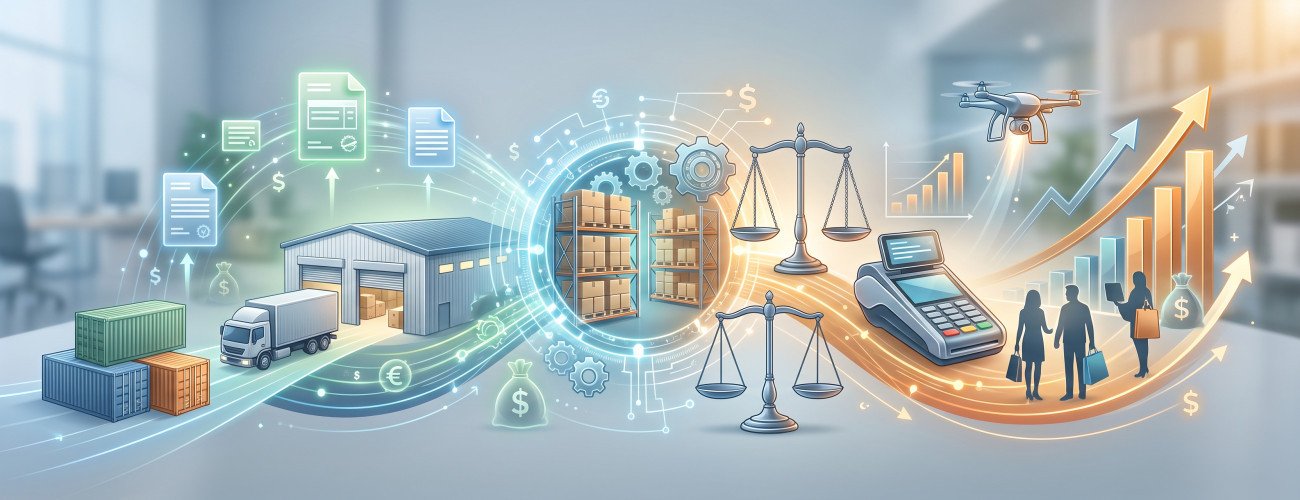
Sales and purchases accounting is considered one of the important pillars in the financial system of commercial enterprises; the impact of selling is not limited to recording revenues, nor does purchasing mean merely proving the value of goods or expenses. Rather, each transaction is linked to customer and supplier accounts, inventory, Value Added Tax (VAT), cash, banks, and financial reports.
Proper accounting treatment begins before entering the entry itself, through the existence of a document proving the transaction, then recording it in the appropriate account, posting it to the ledger, and showing its results within the financial reports. With the increase in the number of transactions, relying on manual recording or scattered files becomes more prone to errors.
An integrated accounting system such as the Accounting and Point of Sale System can combine sales, purchases, and inventory within an interconnected cycle, instead of repeatedly entering data in multiple places.
What is Sales and Purchases Accounting?
Sales and purchases accounting means recording, processing, and reviewing transactions related to selling goods or services and purchasing goods or expenses, while monitoring their impact on revenues, costs, customers, suppliers, inventory, and taxes.
Its two aspects can be clarified as follows:
| Sales Accounting | Purchases Accounting |
|---|---|
| Customer Invoices | Supplier Invoices |
| Revenues | Purchases and Costs |
| Customers and Debtors | Suppliers and Creditors |
| Collection | Payment |
| Sales Returns | Purchases Returns |
| Output Tax | Eligible Input Tax |
| Inventory decrease upon selling goods | Inventory increase upon purchasing goods |
Sales cannot be separated from purchases when looking at financial performance; the inventory purchased today may later become part of the cost of the products sold by the enterprise.
How is the Sales Accounting Cycle Performed?
The sales cycle starts with the customer's need and ends with the collection of dues and the appearance of the transaction's impact in the financial reports.
In commercial enterprises, the process can go through the following stages:
- Receiving the customer's request.
- Preparing a quotation when needed.
- Approving the sales order.
- Preparing the requested items.
- Issuing the delivery or issue note.
- Issuing the sales invoice.
- Proving the customer's balance in case of a credit sale.
- Proving the collection process.
- Updating inventory quantities.
- Updating accounts and reports.
The documentary cycle for sales follows a similar sequence, starting with the quotation and sales order, then moving to the delivery note and invoice, and ending with proving the customer's account and the receipt voucher.
You can benefit from the Distribution System when you need to organize operations related to the sales and delivery movement in a more interconnected manner.
How is the Sales Entry Recorded?
The method of proving the sales entry is determined by the nature of payment, whether the sale is in cash or on credit, in addition to the tax treatment and inventory management method.
Cash Sales
When completing the sale of a product for immediate payment, the entry in its simplified form is:
Dr. Cash or Bank / Cr. Sales / Cr. Output Tax (when applicable)
In the case of applying the perpetual inventory system, the impact of the cost of goods sold and the resulting decrease in inventory are also recorded.
Credit Sales
When the sale is made without collecting the value at the same time:
Dr. Customers / Cr. Sales / Cr. Output Tax (when applicable)
And when receiving the amount at a later time:
Dr. Cash or Bank / Cr. Customer
Therefore, it is not enough to rely on total sales alone; customer balances, amounts due, and what has been actually collected should also be monitored.
How is the Purchases Accounting Cycle Performed?
The purchases cycle begins with a real need in the enterprise, and does not start only upon receiving an invoice from a supplier.
This cycle often includes the following stages:
- Submitting a purchase request.
- Reviewing the need.
- Obtaining supplier quotations.
- Issuing a purchase order.
- Receiving and inspecting items.
- Proving the receipt note.
- Receiving the supplier's invoice.
- Recording purchases or inventory.
- Proving the supplier's account.
- Executing payment.
- Reconciling the supplier's balance.
One of the essential controls before payment is performing a match between the purchase order, the receipt note, and the supplier's invoice, to ensure that the required payment amount corresponds to items that were actually ordered and received.
This cycle is directly linked to inventory, and the Procurement System can be utilized to organize purchase requests, supplier orders, and track related operations.
How is the Purchases Entry Recorded?
The accounting treatment varies depending on the nature of the purchases, the inventory management method, and whether the transaction value will be paid immediately or on account.
When purchasing goods on credit, the entry in its simplified form can be:
Dr. Purchases or Inventory / Dr. Deductible Input Tax (upon meeting its conditions) / Cr. Supplier
And when paying the amount due to the supplier:
Dr. Supplier / Cr. Bank or Cash
However, when the invoice relates to an operating expense, the appropriate expense account is used instead of the inventory or purchases account.
Therefore, it is incorrect to handle all supplier invoices in the same accounting manner; purchasing goods for resale is different from paying rent or acquiring a fixed asset.
What is the Relationship of Sales and Purchases to Inventory?
Inventory represents the main connecting link between sales and purchases within enterprises that deal in goods.
Upon executing a purchase transaction:
Inventory quantity increases.
And upon executing a sales transaction:
Inventory quantity decreases and accounting shows the cost of goods sold according to the applied system.
Consequently, recording a sales invoice without reflecting its impact on inventory, or recording a purchase invoice without updating the quantity, may lead over time to a difference between the actual balance and the recorded balance in the system.
The impact of inaccurate inventory data may extend to the cost of sales, profitability, and financial reports.
Integrated systems help link sales and purchases transactions to the movement of items instead of modifying quantities manually.
Therefore, a Sales and Inventory Management System can be used to link product movement with relevant operations.
How Does Value Added Tax (VAT) Affect Sales and Purchases?
An enterprise registered for VAT needs to distinguish between output tax resulting from sales and input tax related to purchases that are eligible for deduction according to regulations.
In simple terms:
Net Tax = Output Tax − Deductible Input Tax
Accordingly, the total invoice should not be treated entirely as revenue or cost; the tax amount must be separated within the accounts and the sales and purchases balances reviewed against the tax return.
How Are Sales and Purchases Returns Recorded?
Returns operations should be recorded separately, as they represent a partial reversal of the original transaction and may affect inventory, customers, or suppliers, as well as the tax treatment.
Sales Return
When a customer returns previously sold goods, the following may change:
● Sales returns.
● Customer balance or cash.
● Tax.
● Inventory, if the returned goods are suitable for resale.
Purchases Return
When the enterprise returns goods to the supplier, the following elements are affected:
● Value of purchases or inventory.
● Supplier balance.
● Tax related to the transaction.
● Inventory quantity.
Therefore, it is better to link the return to the original invoice whenever possible, rather than making direct adjustments to the balances.
What Are the Most Important Sales and Purchases Accounting Reports?
Management does not only need to know the total sales, but it also needs a set of reports that help it monitor business details.
Among the most prominent of these reports:
● Daily and monthly sales.
● Sales by customer.
● Sales by product.
● Gross profit.
● Customers and aging of debts.
● Purchases by supplier.
● Supplier balances.
● Purchases by item.
● Returns.
● Inventory movement.
● Cost of sales.
● Output and input tax.
● Cash flows.
● Profit and loss.
Financial reports include reports linked to customers, suppliers, inventory, sales, and purchases, in addition to the main financial statements.
You can explore Accounting and Reporting Solutions that help gather this data within a single system.
How Do You Review Sales and Purchases Accounts Monthly?
Before closing the monthly period, you can rely on the following checklist:
● Comparing total sales invoices with the revenue account.
● Reconciling collected amounts with customer balances.
● Reviewing cash sales against petty cash and bank balances.
● Examining discounts and return transactions.
● Reconciling purchases with supplier invoices.
● Reviewing supplier balances and what has been paid.
● Reconciling received items with inventory data.
● Reviewing output and input tax balances.
● Ensuring entry of invoices that have not been recorded yet.
● Verifying inventory discrepancies.
● Extracting the trial balance.
● Studying unusual changes compared to the previous period.
This review contributes to discovering and correcting errors before they reflect on the financial statements or tax declarations.
How Does an Accounting System Help in Managing Sales and Purchases?
An integrated accounting software helps reduce the repetitive recording of a single transaction in more than one place.
When issuing a sales invoice, the following can be affected at the same time:
Customer Accounts + Revenues + Tax + Inventory + Payment Method + Reports.
Also, a purchase invoice can reflect on:
Supplier Account + Inventory or Expense + Tax + Liability + Reports.
Consequently, the interconnectedness of these operations within a single system reduces the need to manually transfer data between sales, purchases, inventory, and accounts.
The enterprise can explore Procurement Management Solutions alongside its accounting system to organize and track purchasing operations.
A Point of Sale System can also be used to support sales operations and record them within an interconnected cycle.
Frequently Asked Questions About Sales and Purchases Accounting
What is meant by Sales Accounting?
It is the process of proving and tracking the sales of goods or services and the resulting revenues, customer accounts, tax, inventory movement, collections, and returns.
What is meant by Purchases Accounting?
It is the recording and tracking of purchases of goods, services, and expenses from suppliers, and the related inventory, liabilities, payments, returns, and tax.
What is the difference between sales and purchases from an accounting perspective?
Sales usually lead to generating revenue and creating receivables from customers or cash flows, while purchases may result in an increase in inventory, expenses, or assets, along with forming a liability to the supplier in credit purchases.
What is the difference between cash sales and credit sales?
In cash sales, the enterprise receives the transaction value at the time of sale, whereas a credit sale creates a balance due from the customer until payment is made.
Are purchases considered an expense?
Not necessarily. Purchasing goods intended for resale may be treated as inventory or purchases according to the accounting system, while some purchases represent operating expenses or assets, and the treatment varies depending on the nature of each case.
Can sales and purchases be linked to inventory automatically?
Yes, integrated accounting systems can update inventory balances upon recording purchases, sales, and returns, thereby linking the movement of items to the relevant financial transactions.
Conclusion
The efficiency of sales and purchases accounting depends on tracking the transaction from its beginning to its end, rather than merely proving the invoice. Sales are linked to customers, collection, inventory, revenues, and tax, while purchases are linked to suppliers, payment, inventory, costs, and input tax.
When these operations are interconnected within a single system, reconciling accounts and inventory and preparing reports become easier, and the need to manually transfer data between departments is reduced.
The enterprise can benefit from an integrated accounting system that links sales, purchases, inventory, point of sale, and reports within one cycle, then register and get a free trial to test a cycle that starts from a purchase invoice and extends to sales, collection, and financial reporting.
Start managing your business with full flexibility
Try Aamal Raqmia for free. Start issuing your ZATCA-compliant e-invoices in minutes.