
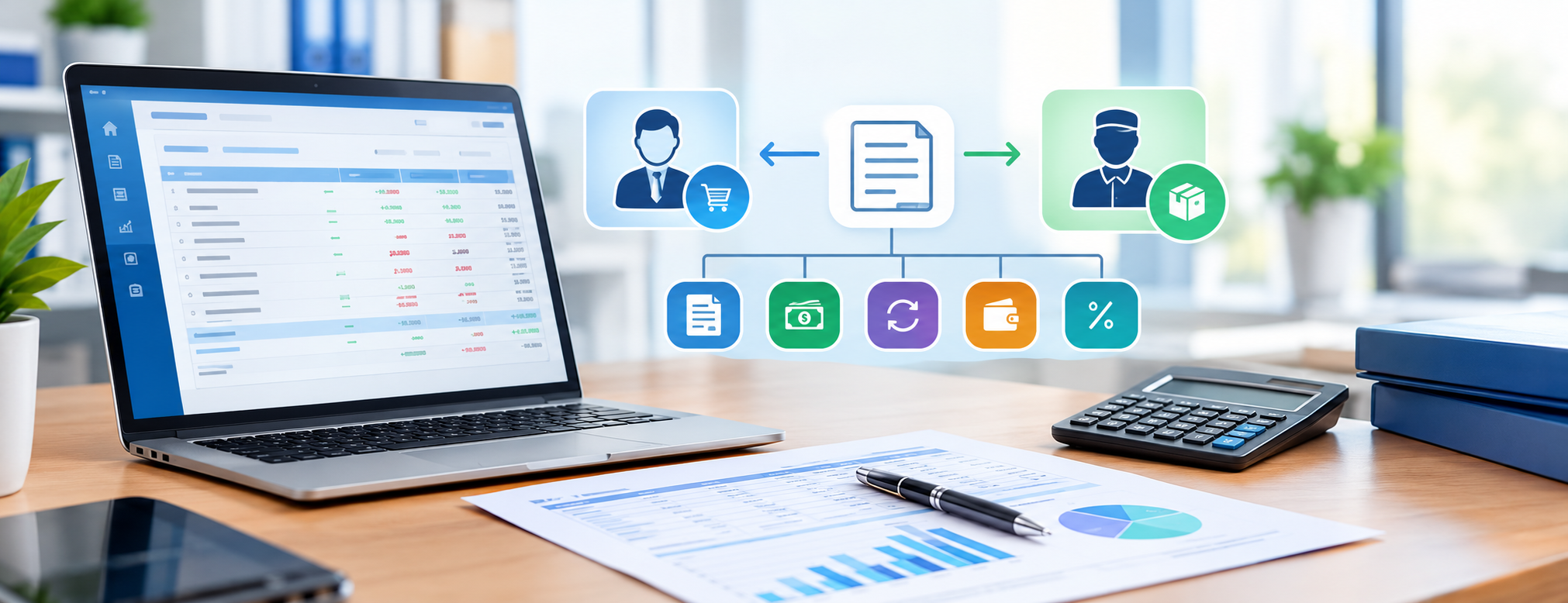
With the expansion of credit sales and purchases, management and accountants face numerous questions: What is the value of receivables from each customer? Which invoices remain unpaid so far? What are the total obligations towards suppliers? Have payments been properly recorded in the accounts? And what is the reason for the discrepancy between the company's balance and the balance reported in the other party's account statement?
The importance of the customer and supplier account statement lies in documenting all financial transactions with each customer or supplier over a specific period, starting from the opening balance, through invoices, payments, returns, and adjustments, and ending with the closing balance.
At Nezami Pro, we consider an account statement to be a tool for control and auditing that goes beyond being a mere paper report; it allows management and accountants to track the causes of balances, monitor receivables, and detect errors before they accumulate and become harder to resolve.
An integrated accounting system enables the management of customer and supplier accounts, linking sales, purchases, collection, and payment transactions to accounting records and reports within a single ecosystem. You can learn about the Point of Sale System to understand how commercial operations are linked to accounts.
What is Meant by a Customer and Supplier Account Statement?
It is an accounting report that reviews the financial movements recorded in a customer's or supplier's account during a specific time period, illustrating the impact of each transaction on the balance up to its final value.
The account statement may include the following elements:
- Beginning of period balance.
- Sales or purchase invoices.
- Sales or purchase returns.
- Cash receipt vouchers.
- Cash payment vouchers.
- Applied discounts.
- Credit and debit notes.
- Accounting entries and adjustments.
- The resulting balance after each transaction.
- The closing balance for the period.
The primary purpose of this report is to answer a clear question:
What transactions led the customer's or supplier's account to its current balance?
You can also review Accounting and Sales Management Solutions to learn about mechanisms for organizing financial and commercial operations.
What is the Difference Between a Customer Account Statement and a Supplier Account Statement?
The report may look similar in shape when dealing with customers and suppliers, but the accounting purpose of each differs according to the nature of the transaction.
Customer Account Statement
Used to monitor funds not yet collected by the business from the customer.
Account movements typically unfold as follows:
Issuing a credit sales invoice → Increase in the amount owed by the customer
And upon collecting part of the amount:
Receiving a payment from the customer → Decrease in remaining receivables
Supplier Account Statement
Helps track financial obligations that the business must pay to the supplier.
Movement usually starts through:
Recording a credit purchase invoice → Increase in the amount owed to the supplier
Then upon settlement:
Paying an amount to the supplier → Decrease in the outstanding balance
| Comparison Element | Customer | Supplier |
|---|---|---|
| Nature of Transaction | The business sells to them | The business buys from them |
| Primary Document | Sales Invoice | Purchase Invoice |
| Funds Movement | Collecting dues from the customer | Settling dues to the supplier |
| Account Type | Accounts Receivable | Accounts Payable |
| Goal of Tracking | Monitor collected and remaining amounts | Monitor obligations and due dates |
To gain a more comprehensive understanding of the impact of commercial operations on accounts, you can review the Procurement System, which is linked to the purchasing cycle, invoices, payments, and inventory.
What Information Should an Account Statement Include?
For an account statement to perform its auditing role effectively, it should display movement details rather than just showing the final balance.
Ideally, it should contain the following data:
| Field | Benefit |
|---|---|
| Date | Determine the chronological order of transactions |
| Document Number | Facilitate reference back to invoices and vouchers |
| Movement Classification | Clarify whether it is a sale, purchase, receipt, payment, or return |
| Details | Explain the nature of the recorded transaction |
| Debit | Display amounts posted to the debit side |
| Credit | Display amounts posted to the credit side |
| Balance | Show account result after each transaction |
The document number is considered a core element in the statement because it helps transition from any accounting discrepancy to the original transaction and verify it.
Ready to try the system?
Start using the free trial version, or contact the sales team for help in choosing the right solution.
Illustrative Example of a Customer Account Statement
Let's assume the month starts without any prior balance on the customer.
| Transaction Type | Value | Remaining Due from Customer |
|---|---|---|
| Beginning of Period Balance | 0 | 0 |
| Sales Invoice | 10,000 SAR | 10,000 |
| Collection from Customer | 4,000 SAR | 6,000 |
| Additional Sales Invoice | 5,000 SAR | 11,000 |
| Sales Return | 1,000 SAR | 10,000 |
| Another Payment | 3,000 SAR | 7,000 |
Ready to try the system?
Start your free trial or talk to the sales team to help you choose the right solution.
Accordingly, the balance at the end of the period is as follows:
Remaining Amount Due from Customer = 7,000 SAR
The benefit of the statement is not limited to determining the 7,000 SAR amount, but extends to explaining how this balance was formed through the recorded transactions.
Illustrative Example of a Supplier Account Statement
Let's assume the business conducted the following transactions with a supplier:
- Purchase invoice valued at 20,000 SAR.
- Payment of 8,000 SAR.
- Another purchase invoice valued at 5,000 SAR.
- Purchase return valued at 2,000 SAR.
The remaining balance is calculated as follows:
20,000 - 8,000 + 5,000 - 2,000 = 15,000 SAR
Therefore, the value of the remaining obligation to the supplier at the end of the period is:
15,000 SAR
It should be possible to review this amount by referring to the purchase invoices, payment vouchers, and return documents recorded in the statement.
How to Understand Debit and Credit Balances?
Explaining the nature of the balance represents one of the points that may cause confusion when reading accounting reports.
According to standard accounting treatment:
Customer
The customer's account usually appears with a debit balance when they are required to pay an amount to the business.
Supplier
The supplier's account usually appears with a credit balance when the business has a financial obligation towards them.
However, balances may appear contrary to this picture in some cases.
Examples include:
- The customer paying an advance amount before the invoice is issued.
- The business paying an advance amount to the supplier.
- Returns exceeding the existing balance.
- Performing an accounting adjustment on the account.
Therefore, a reverse balance should not be considered definitive proof of an error; rather, the movements that led to its appearance must be examined first.
What Are the Reasons for Discrepancies Between Customer or Supplier Account Statements?
A frequent situation during reconciliation is when a supplier states, for example:
"Your account balance with us is 25 thousand SAR"
While the company's accounting system shows the following balance:
"22 thousand SAR"
This discrepancy is not handled simply by changing the balance value, but by identifying the transaction that caused the difference.
Among the most prominent potential reasons:
- Recording an invoice by one party without entering it by the other party.
- Failure to record one of the payments.
- Recording a payment to an incorrect customer or supplier account.
- Failure to record a return document.
- Entering the same invoice more than once.
- Difference in the timing of transaction recording.
- Omitting a credit or debit note.
- Entering an inaccurate opening balance.
- Failure to calculate an eligible discount.
- An error in the invoice value or the tax calculated on it.
Therefore, the best way to handle differences is to review movement details and compare them, rather than settling for comparing the final balance.
You can learn about the Accounting System and Point of Sale to explore solutions that help organize accounts and monitor financial operations.
What Are the Steps for Reconciling a Customer Account Statement?
Start by reviewing actual documents and movements, and do not attempt to alter numbers just to reach a matched balance.
Step 1: Select the Period Required for Reconciliation
For example:
From January 1 to January 31
Step 2: Review the Opening Balance
If the beginning of period balance differs between the two statements, this difference is likely to reflect on subsequent balances.
Step 3: Verify Invoices
Check the following data:
- Invoice number.
- Issue date.
- Financial value.
- Tax value.
- Returns associated with invoices.
Step 4: Review Payment and Collection Operations
Check each of the following:
- Receipt voucher.
- Bank transfer.
- Cash payment.
- Settlement notice.
Step 5: List Unmatched Transactions
Prepare a list of transactions that appear in one statement and do not exist in the other.
Step 6: Address the Cause of Discrepancy
After identifying the cause, record the correct document or execute the appropriate settlement according to the approved accounting procedures in the business.
It is not recommended to manually change the closing balance before identifying and resolving the source of the discrepancy.
How is a Supplier Account Statement Reconciled?
Supplier account reconciliation relies on the same steps, focusing on the following elements:
- Recorded purchase invoices.
- Payments made to the supplier.
- Purchase returns.
- Eligible discounts.
- Amounts paid in advance to suppliers.
- Opening balances.
It is necessary to verify that each purchase invoice is linked to the correct supplier, especially in businesses dealing with multiple branches or suppliers with similar trade names.
What is the Difference Between an Account Statement and an Aging of Accounts Report?
An account statement displays details of transactions that resulted in the current balance.
As for the aging of accounts report, it shows the duration that has passed on amounts that have not been paid yet.
For example, the total balance of a customer might be:
100,000 SAR
While the aging report distributes the amount across the following periods:
| Debt Time Period | Value |
|---|---|
| Less than 30 days | 40,000 |
| From 31 to 60 days | 25,000 |
| From 61 to 90 days | 20,000 |
| More than 90 days | 15,000 |
Ready to try the system?
Start your free trial or talk to the sales team to help you choose the right solution.
Through this distribution, management can know that the amount of 15 thousand SAR has exceeded 90 days past due, rather than just knowing the total indebtedness.
Therefore, the collection team benefits from using the account statement and the aging of accounts report together.
What is the Importance of Customer Account Statements in Tracking Collections?
The organized collection process begins by identifying the amounts required to be collected from each customer and knowing their details.
When contacting the customer, the employee should have the following information available:
- Total outstanding amount.
- Unpaid invoices.
- Issue date of each invoice.
- Payments previously collected.
- Recorded returns.
- Amounts overdue past their payment date.
The availability of these data helps reduce disputes and allows discussing each invoice and amount clearly.
The usefulness of an account statement increases when it is directly connected to sales invoices and receipt vouchers recorded in the system.
How Does Supplier Account Statement Contribute to Liquidity Planning?
Supplier balances represent financial obligations on the business, which is why the financial officer needs to monitor the following information:
- Value of receivables for each supplier.
- Payment due dates.
- Unpaid invoices.
- Advance payments to suppliers.
- Total obligations towards all suppliers.
These data help organize cash flows and plan for payments in advance, rather than discovering obligations only when their due date approaches.
What Are the Problems Resulting from Distributing Accounts Between Excel and Multiple Programs?
Audit difficulties usually appear when data is distributed across more than one source, such as:
- Recording the invoice in the sales software.
- Proving payment in the bank statement.
- Managing the supplier's account through Excel.
- Tracking inventory using a separate program.
- Relying on the accountant to know the final balance.
In such a case, the employee is forced to gather information from multiple sources to determine the correct balance.
Therefore, integrated accounting systems help organize the workflow according to the following sequence:
Invoice → Customer or Supplier Account → Receipt or Payment → Account Balance → Report
All within a single database.
If your business needs to link customer and supplier accounts with sales, purchases, inventory, and reports, you can check out Integrated Accounting and Point of Sale Solutions.
How Does the Accounting System Help Manage Customer and Supplier Accounts?
Integrated accounting systems allow the management of sales and purchase operations and customer and supplier accounts within an interconnected accounting cycle.
Thus, every financial movement is linked to the document that produced it.
When issuing a credit sales invoice:
The transaction is recorded within the customer's sales and account movement.
And when proving a collection payment:
The balance changes according to the value of the recorded payment.
The same principle applies to supplier accounts when recording purchase invoices and related payments.
This interconnection helps extract and review account statements more easily and limits the need to manually enter the same transaction in multiple places.
What Are the Most Prominent Reports Related to Customer and Supplier Accounts?
It is best not to rely on the account statement alone, but to benefit from other associated reports.
Among the most important of these reports:
- Customer balance reports.
- Supplier balance reports.
- Detailed account statements.
- Sales reports by customer.
- Purchases reports by supplier.
- Aging of accounts reports.
- Lists of unpaid invoices.
- Collected amounts reports.
- Payments reports.
- Profit and sales reports.
To track sales, accounts, and inventory data more broadly, you can learn about Accounting Reports and Performance Tracking Solutions.
How to Verify the Account Statement Before Sending It to the Customer?
You can rely on the following checklist:
- Verify the correctness of the customer's name.
- Ensure the specified time period.
- Review the opening balance.
- Verify invoice numbers.
- Review all collection and payment operations.
- Ensure returns are recorded.
- Review credit notes.
- Search for transactions recorded more than once.
- Reconcile the balance with the subsidiary ledger.
- Verify the correctness of the final balance.
Sending a statement containing incorrect data may lead to disputes with the customer, while this can be avoided by conducting a thorough review before sending.
Frequent Errors in Managing Customer and Supplier Accounts
There is a set of practices that are preferred to be avoided when managing accounts, including:
- Opening multiple accounts for the same customer.
- Assigning a payment to a different customer's account.
- Neglecting to review the opening balance.
- Deleting an invoice instead of performing the correct accounting treatment.
- Failing to record returns.
- Delaying the recording of payments.
- Omitting periodic account reconciliation.
- Relying on the final balance without examining invoices.
- Failing to follow up on old debts.
- Separating sales and purchase data from accounts.
Whenever transactions are recorded at the time they occur, reviewing accounts and reconciling balances becomes much easier.
Frequently Asked Questions About Customer and Supplier Account Statements
What is meant by customer and supplier account statements?
It is an accounting report that aggregates recorded transactions for a customer or supplier over a specific period, including invoices, payments, returns, and adjustments, and displays the balance resulting from each movement.
How can an account statement be prepared for a customer?
Select the customer and the required time period, then review the opening balance, sales invoices, collected amounts, returns, and adjustments, while calculating the balance after each transaction.
What is the difference between a customer account statement and a supplier account statement?
A customer statement shows amounts not yet collected by the business from them, while a supplier statement illustrates obligations owed by the business to the supplier, along with purchase invoices and related payments.
What does a customer's debit balance indicate?
It mostly indicates the existence of an amount due to the business from the customer, with the importance of reviewing account details before judging unusual cases.
What is the significance of a supplier's credit balance?
It usually indicates the presence of a financial amount owed by the business to the supplier.
What are the reasons for discrepancies between the account statement and the customer's statement?
Discrepancies may result from an invoice, payment, return, or note not recorded by one of the parties, or from an error in the opening balance.
Can the accounting system manage customer and supplier accounts?
Integrated accounting systems link customer and supplier accounts with sales, purchases, accounts, inventory, and reports, making it easier to track movements and balances from one place.
Conclusion
Customer and supplier account statements should not be viewed merely as reports showing a final value, but rather as a record explaining the transactions that led to the formation of that balance.
The accounting cycle runs in an organized manner according to the following sequence:
Invoice → Account Movement → Receipt or Payment → Return or Adjustment → Final Balance → Reconciliation
When these operations are interconnected within the system, discovering discrepancies, tracking collections and obligations, and making financial decisions becomes clearer and easier.
Accounting and Point of Sale Solutions help link customer and supplier accounts with sales, purchases, inventory, and reports, instead of distributing information among separate files and programs.
You can also book a consultation to learn about appropriate solutions for your business, then register and get the trial period to experience adding a customer, supplier, invoice, and payment, and extract an actual account statement before adopting the system in your business.
Start Managing Your Business with Complete Flexibility
Try Nezami Pro for free. Start issuing your ZATCA-compliant electronic invoices within minutes.