
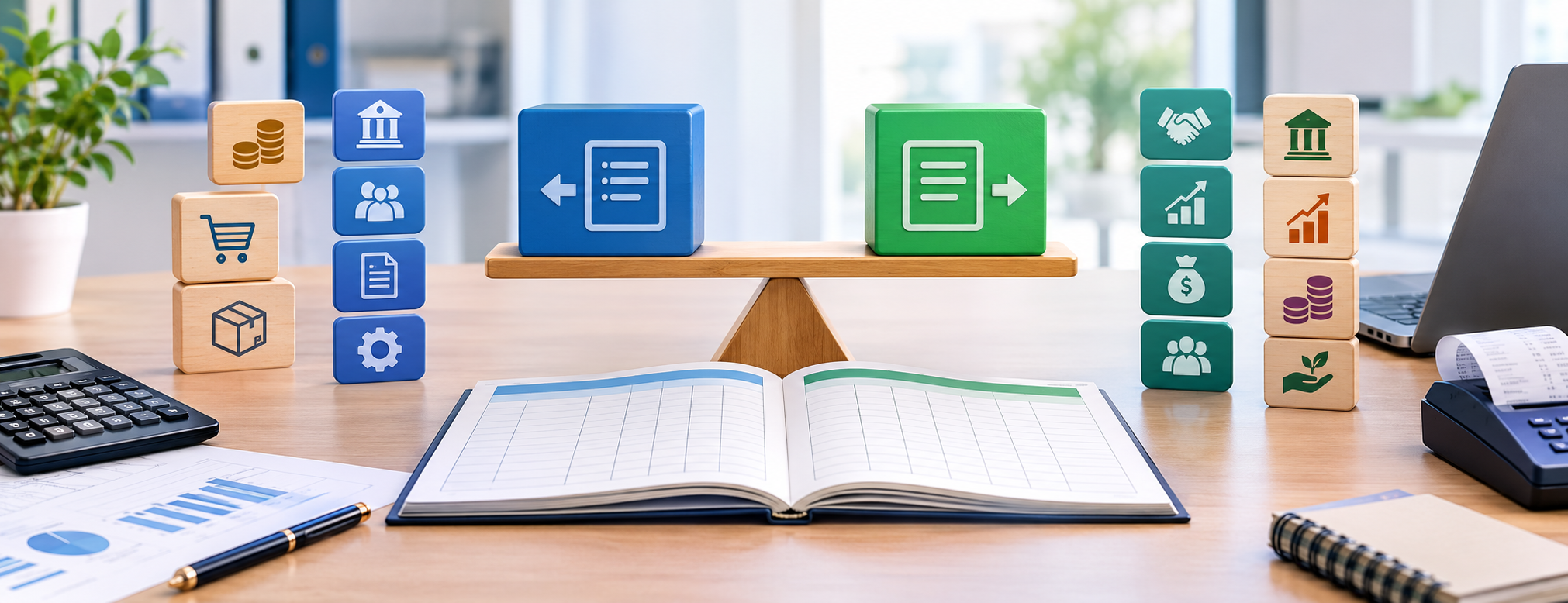
The difference between a debit and a credit in accounting is that a debit refers to the left side of an accounting entry, while a credit refers to the right side, and the significance of each side varies according to the nature of the account being processed.
When assets or expenses increase, the increase is recorded on the debit side, whereas increases in liabilities, equity, and revenues are recorded on the credit side.
It is important to realize that the term debit does not necessarily mean someone is obliged to pay a debt, nor does the term credit always mean someone is owed a monetary amount. For example, when the cash balance increases, the increase is recorded as a debit because it is an asset, while an increase in sales is recorded as a credit because it represents revenue.
The core accounting rule is based on the following:
The total debit amounts must equal the total credit amounts in every balanced accounting entry.
To understand this rule practically, it is preferable to focus on the nature of the account rather than memorizing accounting entries. Once you determine whether an account is an asset, liability, revenue, or expense, choosing the appropriate side becomes clearer.
You can learn about the relationship between daily operations and accounting records by utilizing accounting and point of sale systems that link financial operations with accounts and reports.
What is Meant by Debit and Credit in Accounting?
The term Debit refers to the left side of an accounting entry, while the term Credit refers to the right side.
Determining which account is recorded on each side depends on the account classification and the nature of the change resulting from the financial transaction.
| Account Classification | Upon Increase | Upon Decrease |
|---|---|---|
| Assets | Debit | Credit |
| Expenses | Debit | Credit |
| Liabilities | Credit | Debit |
| Equity | Credit | Debit |
| Revenues | Credit | Debit |
These rules form a foundation that helps determine the correct accounting treatment in most financial transactions.
How to Determine the Debit and Credit Accounts?
You can analyze any accounting transaction by following three main steps:
- Determine the accounts affected by the financial transaction.
- Know the accounting classification of each account.
- Determine whether the value of the account has increased or decreased.
Suppose the entity purchased a device and paid its value in cash amounting to 5,000 SAR.
Since the device is an asset whose value increased with the entity, it is recorded as a debit. As for cash, it is an asset whose balance decreased due to the payment, and therefore it is recorded as a credit.
Accounting Entry for Purchasing a Device in Cash
| Account | Debit | Credit | Accounting Explanation |
|---|---|---|---|
| Equipment | 5,000 SAR | — | Increase in asset |
| Cash / Fund | — | 5,000 SAR | Decrease in asset |
| Total | 5,000 SAR | 5,000 SAR | Balanced entry |
This example illustrates that determining both sides of the entry is related to account classification and the direction of change in its value, rather than memorizing the form of the entry without understanding it.
Example of Recording Cash Sales
If the entity sold products and received their value in cash amounting to 10,000 SAR, excluding tax and cost of goods sold to simplify the example, the treatment is as follows.
The sales process leads to an increase in cash, which is an asset recorded as a debit upon increase. In contrast, sales revenues increase, and therefore they are recorded as a credit.
Accounting Entry for Cash Sales
| Account | Debit | Credit | Accounting Explanation |
|---|---|---|---|
| Cash / Fund | 10,000 SAR | — | Increase in asset |
| Sales | — | 10,000 SAR | Increase in revenue |
| Total | 10,000 SAR | 10,000 SAR | Balanced entry |

The example shows that describing the cash account as a debit does not mean it owes money to someone else, but rather indicates recording the increase on the debit side of the entry.
Why Does the Customer Appear on the Debit Side?
When the entity sells products or services to a customer with delayed payment, it gains a financial right due from the customer, which is why their account is usually recorded on the debit side.
For example, the entity issued a credit sales invoice worth 20,000 SAR.
Credit Sale Entry to the Customer
| Account | Debit | Credit | Accounting Explanation |
|---|---|---|---|
| Customer | 20,000 SAR | — | Increase in accounts receivable |
| Sales | — | 20,000 SAR | Rise in revenues |
| Total | 20,000 SAR | 20,000 SAR | Balanced entry |
If the customer later pays an amount of 7,000 SAR, the collection is recorded as follows.
Entry for Collecting Part of the Customer's Dues
| Account | Debit | Credit | Accounting Explanation |
|---|---|---|---|
| Bank or Cash | 7,000 SAR | — | Increase in cash |
| Customer | — | 7,000 SAR | Decrease in customer dues |
| Total | 7,000 SAR | 7,000 SAR | Balanced entry |
After collecting this amount, the remaining balance due from the customer becomes as follows:
20,000 - 7,000 = 13,000 SAR Debit
This demonstrates the importance of linking sales invoices and collected amounts to the customer's account in the accounting system to ensure the accuracy of due balances.
The point of sale system helps organize sales operations and record them, while the integrated accounting system enables monitoring customer accounts and collections within an interconnected financial cycle.
Why Does the Supplier Appear on the Credit Side?
If the entity purchases from a supplier with an agreement to pay later, a financial liability arises towards the supplier, which is why the supplier's account is usually established on the credit side.
Suppose the entity purchased goods on account worth 30,000 SAR.
Credit Purchase Entry from Supplier
| Account | Debit | Credit | Accounting Explanation |
|---|---|---|---|
| Purchases or Inventory | 30,000 SAR | — | Increase in purchases or asset |
| Supplier | — | 30,000 SAR | Increase in liability to supplier |
| Total | 30,000 SAR | 30,000 SAR | Balanced entry |
When the entity pays the supplier an amount of 10,000 SAR, the entry is as follows.
Entry for Paying Supplier Dues
| Account | Debit | Credit | Accounting Explanation |
|---|---|---|---|
| Supplier | 10,000 SAR | — | Decrease in liability |
| Bank or Cash | — | 10,000 SAR | Decrease in cash |
| Total | 10,000 SAR | 10,000 SAR | Balanced entry |
Ready to try the system?
Start your free trial or talk with the sales team to help you choose the right solution.
After paying the amount, the remaining value due to the supplier is as follows:
30,000 - 10,000 = 20,000 SAR Credit
To learn about the accounting treatment for purchase and sale movements, you can review the Procurement Management System which helps organize purchasing operations and monitor suppliers.
What is the Difference Between a Debit Customer and a Credit Supplier?
| Financial Transaction | Affected Account | Accounting Impact |
|---|---|---|
| Credit sale to customer | Customer | Debit |
| Receiving amount from customer | Customer | Credit and leads to reducing his balance |
| Credit purchase from supplier | Supplier | Credit |
| Paying amount to supplier | Supplier | Debit and leads to reducing his balance |
The idea can be clarified in the following two points:
Debit Customer: A financial amount owed to the entity by the customer.
Credit Supplier: A financial amount the entity must pay to the supplier.
However, customer balances may appear as credit, and supplier balances may appear as debit in some cases.
Is It Possible for a Customer to Be a Creditor?
Yes, a customer's account may appear with a credit balance in a number of cases, including:
- The customer pays an advance amount to the entity.
- The customer pays an amount exceeding the dues on them.
- Recording a return after the customer has paid the invoice.
- A balance appearing in favor of the customer as a result of an accounting adjustment.
For example, if the customer deposits an advance amount of 5,000 SAR before issuing a sales invoice, the entry is as follows.
Entry for Receiving an Advance Payment from a Customer
| Account | Debit | Credit |
|---|---|---|
| Bank or Cash | 5,000 SAR | — |
| Customer Account | — | 5,000 SAR |
| Total | 5,000 SAR | 5,000 SAR |
Ready to try the system?
Start your free trial or talk with the sales team to help you choose the right solution.
In this case, the customer's account may appear as a credit until the advance payment is settled with an invoice issued later.
Can a Supplier Be a Debtor?
Yes, a supplier's account may become a debit if the entity transfers an advance amount to them before receiving goods or recording the related purchase invoice.
Example of Paying an Advance Amount to a Supplier
| Account | Debit | Credit |
|---|---|---|
| Supplier | 10,000 SAR | — |
| Bank or Cash | — | 10,000 SAR |
| Total | 10,000 SAR | 10,000 SAR |
Therefore, it is not sufficient to look at the balance description as debit or credit to judge its validity, but rather the previous transactions that led to its formation should be analyzed.
How Are Debit and Credit Presented in the Account Statement?
The account statement usually includes a set of basic data, which are:
- Transaction date.
- Document number.
- Transaction description or particulars.
- Debit amount.
- Credit amount.
- Resulting balance.
The movement of a customer's account can be illustrated by the following example:
| Transaction | Debit | Credit | Debit Balance |
|---|---|---|---|
| Sales invoice | 10,000 | — | 10,000 |
| Collection from customer | — | 4,000 | 6,000 |
| Additional sales invoice | 5,000 | — | 11,000 |
| Collection from customer | — | 3,000 | 8,000 |
Ready to try the system?
Start your free trial or talk with the sales team to help you choose the right solution.
Based on these movements, the final balance of the account is as follows:
8,000 SAR Debit
This highlights the importance of knowing how both sides of the entry work when examining customer and supplier account statements and reviewing balances.
What is the Difference Between Debit and Credit in Assets and Liabilities?
Assets
Examples of accounts classified under assets include:
- Cash / Fund.
- Bank accounts.
- Customers / Accounts Receivable.
- Inventory.
- Equipment.
| Change in Asset | Recording Method |
|---|---|
| Rise in asset value | Debit |
| Decrease in asset value | Credit |
Liabilities
Liabilities include financial obligations, for example:
- Supplier accounts.
- Loans.
- Amounts due on the entity.
| Change in Liability | Recording Method |
|---|---|
| Increase in liability | Credit |
| Decrease in liability | Debit |
Example of Obtaining a Loan
If the entity obtained funding worth 100,000 SAR and deposited the amount into its bank account, the entry is as follows:
| Account | Debit | Credit | Accounting Reason |
|---|---|---|---|
| Bank | 100,000 SAR | — | Increase in asset |
| Loan | — | 100,000 SAR | Increase in liability |
| Total | 100,000 SAR | 100,000 SAR | Balanced entry |
Ready to try the system?
Start your free trial or talk with the sales team to help you choose the right solution.
How Do Revenues and Expenses Affect the Accounting Entry?
The increase in revenues is recorded on the credit side, while the increase in expenses is established on the debit side.
Example of Generating Revenue from a Service
If the entity provided a service to a customer worth 6,000 SAR on account, the transaction can be recorded in the following manner:
| Account | Debit | Credit |
|---|---|---|
| Customer | 6,000 SAR | — |
| Service Revenues | — | 6,000 SAR |
| Total | 6,000 SAR | 6,000 SAR |
Example of Paying Rent Expense
When the entity pays an amount of 4,000 SAR for rent, the entry is recorded as follows:
| Account | Debit | Credit |
|---|---|---|
| Rent Expense | 4,000 SAR | — |
| Bank or Cash | — | 4,000 SAR |
| Total | 4,000 SAR | 4,000 SAR |
These examples illustrate how revenues and expenses are reflected in the accounts associated with the income statement.
How Do Debit and Credit Relate to the Accounting Equation?
Financial accounting is based on the following basic equation:
Assets = Liabilities + Equity
The double-entry system maintains the balance of this equation by recording each financial transaction in a way that ensures the equality of total debit and credit amounts in a single entry.
| Accounting Entry Side | Amount |
|---|---|
| Total Debit | 10,000 SAR |
| Total Credit | 10,000 SAR |
| Difference Between Both Sides | 0 SAR |
Ready to try the system?
Start your free trial or talk with the sales team to help you choose the right solution.
If a discrepancy appears between the totals of both sides, the entry and its details should be examined before approval.
Why Might the Concept of Debit and Credit Differ in a Bank Statement?
Confusion may occur when reading a bank account statement because the bank displays movements from its own perspective, not necessarily in the same way they appear in the entity's records.
As for recording the movement in the company's accounts, the treatment is as follows:
| Change in Bank Account | Treatment in Entity Records |
|---|---|
| Rise in bank balance | Debit |
| Decrease in bank balance | Credit |
When performing bank reconciliation, focus should be placed on how the movement affects the bank balance in the entity's records, rather than relying solely on the column name in the bank statement.
How Does the Accounting System Help Organize Debit and Credit?
An integrated accounting system allows recording transactions through original documents, creating their associated accounting impacts instead of needing to enter every entry manually.
For example, a sales transaction can affect the following accounts:
| Transaction Type | Accounts That May Be Affected |
|---|---|
| Credit sales invoice | Customer – Sales – Tax |
| Selling an item from inventory | Inventory – Cost of Goods Sold |
| Collecting customer dues | Bank or Cash – Customer |
| Purchase invoice | Inventory or Purchases – Supplier |
| Paying supplier dues | Supplier – Bank or Cash |
This integration helps reduce duplicate data entry, while requiring a review of accounting treatment to ensure accounts are prepared and transactions are recorded correctly.
The accounting and point of sale system combines sales, purchases, customer and supplier accounts, inventory, entries, and reports within a single interconnected ecosystem.
How Do You Verify the Validity of an Entry Before Approval?
You can review the accounting entry with the assistance of the following steps:
- Identify the financial transaction that took place.
- Know the accounts affected by it.
- Classify each account according to its nature.
- Determine the direction of change in each account, whether by increase or decrease.
- Apply the appropriate debit and credit rule.
- Verify the equality of the total of both sides.
- Review the document supporting the transaction.
- Ensure the correctness of the date and accounting period.
If the reason for recording an account on the debit or credit side is not clear, it is best to review the entry details before approval.
What Are Common Mistakes Regarding Debit and Credit?
There is a set of mistakes that should be noted when dealing with accounting entries, including:
- Believing that debit always means a person required to pay money.
- Believing that credit always means a person entitled to receive money.
- Memorizing accounting entries without comprehending the nature of accounts.
- Considering any balance contrary to the usual nature of the account as evidence of an error.
- Confusing the accounting treatment of a customer account and a supplier account.
- Changing the balance value directly instead of correcting the transaction that caused the error.
- Neglecting the original supporting document of the transaction.
- Failing to ensure the balance of the accounting entry.
Frequently Asked Questions About the Difference Between Credit and Debit
What is the difference between debit and credit in short?
Debit represents the left side of the entry, while credit represents the right side. Assets and expenses increase on the debit side, whereas liabilities, equity, and revenues increase on the credit side.
Who is meant by debtor and who is meant by creditor?
In accounts receivable, a customer is usually considered a debtor when they have an amount due to the entity, and a supplier is considered a creditor when the entity is required to pay an amount to them. When recording entries, the appropriate side is determined based on the nature of the account.
What is the reason for considering a customer a debtor?
Because credit sales create a financial right for the entity with the customer, and accounts receivable are classified under assets.
Why is a supplier recorded as a creditor?
Because purchasing goods or services on account leads to the creation of a financial liability on the entity towards the supplier, and liabilities increase on the credit side.
Is an expense recorded as debit or credit?
The increase in expense is recorded on the debit side.
Are revenues recorded as debit or credit?
The increase in revenues is established on the credit side.
Is cash a debit or credit account?
Cash is classified under assets; therefore, an increase in its balance is recorded as debit, and its decrease is recorded as credit.
Can a customer's account show a credit balance?
Yes, this can happen if the customer pays an advance amount or pays more than the dues on them, or if a return or adjustment results in an amount in their favor.
Conclusion
The difference between debit and credit is not determined merely by knowing who paid money and who received it, but is related to account classification and the nature of the change that occurred to it.
The basic accounting rule can be reviewed through the following table:
| Account Type | Upon Increase | Upon Decrease |
|---|---|---|
| Assets | Debit | Credit |
| Expenses | Debit | Credit |
| Liabilities | Credit | Debit |
| Revenues | Credit | Debit |
| Equity | Credit | Debit |
When you determine the type of account and know whether its value has increased or decreased, recording accounting transactions becomes easier and clearer, whether related to sales, purchases, collecting money from customers, or paying dues to suppliers.
Integrated accounting systems contribute to linking these operations to accounts and financial reports. You can explore accounting and point of sale solutions that help organize sales, purchases, inventory, and customer and supplier accounts within an interconnected system.
You can also view plans and pricing, or register and take advantage of the trial period to experience recording sales and purchase invoices, collection, and payment, and track the impact of each operation on accounts.
Start managing your business with complete flexibility
Try digital business for free. Start issuing your ZATCA-compliant electronic invoices within minutes.